Abitibi River
| Abitibi River | |
|---|---|
 Abitibi River at Iroquois Falls | |
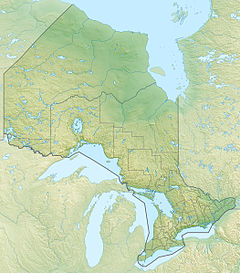  Location of the mouth of the Abitibi River in Ontario | |
| Etymology | Algonquin language |
| Location | |
| Country | Canada |
| Province | Ontario |
| Region | Cochrane District |
| Physical characteristics | |
| Source | Lake Abitibi |
| - location | 38 km east of Iroquois Falls |
| - coordinates | 48°47′06″N 80°10′23″W / 48.78500°N 80.17306°W / 48.78500; -80.17306 |
| Mouth | Moose River |
- location | 30 km SSW from Moosonee |
- coordinates | 51°04′17″N 80°55′32″W / 51.07139°N 80.92556°W / 51.07139; -80.92556Coordinates: 51°04′17″N 80°55′32″W / 51.07139°N 80.92556°W / 51.07139; -80.92556 |
| Length | 540 m (1,770 ft)to head of Lac Loïs [1] |
| Basin size | 29,500 km2 (11,400 sq mi)[1] |
| Basin features | |
| Tributaries | |
| - left | Black River, Frederick House River, North Driftwood River |
| - right | Sucker River, Little Abitibi River |
The Abitibi River is a river in northeastern Ontario, Canada, which flows northwest from Lake Abitibi to join the Moose River which empties into James Bay. This river is 540 kilometres (340 mi) long, and descends 265 metres (869 ft).[2]
The river was an important fur trading route for the Hudson's Bay Company. Now,[when?]pulp and paper, centered on the town of Iroquois Falls, Ontario, is an important industry in the heavily forested region through which it flows.[2] The region also supports tourism and gold mining.[2]
The Abitibi Canyon Generating Station is located on the river at Abitibi Canyon. The experience of surveying the river for the purposes of building this plant was the inspiration for folk singer Wade Hemsworth's "The Black Fly Song".
The name is from the Algonquin words abitah, meaning middle and nipi meaning water.[2]
Contents
1 Tributaries
2 Downstream course
3 See also
4 References
Tributaries
- Little Abitibi River
- Frederick House River
- Black River
Downstream course
- Begins as outlet from Lake Abitibi (48°47′6″N 80°10′23″W / 48.78500°N 80.17306°W / 48.78500; -80.17306)
- Extreme southern point (48°42′26″N 80°38′25″W / 48.70722°N 80.64028°W / 48.70722; -80.64028)
Ansonville, Ontario (48°45′26″N 80°40′43″W / 48.75722°N 80.67861°W / 48.75722; -80.67861)
Iroquois Falls, Ontario (48°46′41″N 80°40′6″W / 48.77806°N 80.66833°W / 48.77806; -80.66833)- Crossed by Ontario Northland Railway (49°12′43″N 81°0′37″W / 49.21194°N 81.01028°W / 49.21194; -81.01028)
- Long Sault Rapids hydroelectric plant (49°12′44″N 81°0′52″W / 49.21222°N 81.01444°W / 49.21222; -81.01444)
- Confluence with the Black River (49°20′58″N 81°6′34″W / 49.34944°N 81.10944°W / 49.34944; -81.10944)
- Confluence with the Frederick House River (49°18′51″N 81°16′58″W / 49.31417°N 81.28278°W / 49.31417; -81.28278)
Ontario Northland Railway crossing at Island Falls Station, Ontario (49°32′53″N 81°22′56″W / 49.54806°N 81.38222°W / 49.54806; -81.38222)
Island Falls, Ontario (49°34′3″N 81°23′16″W / 49.56750°N 81.38778°W / 49.56750; -81.38778)
Abitibi Canyon Generating Station near Fraserdale, Ontario (49°53′42″N 81°34′42″W / 49.89500°N 81.57833°W / 49.89500; -81.57833)
Otter Rapids Generating Station (50°10′57″N 81°38′37″W / 50.18250°N 81.64361°W / 50.18250; -81.64361)
Coral Rapids, Ontario (50°13′17″N 81°40′33″W / 50.22139°N 81.67583°W / 50.22139; -81.67583)- Extreme western point (50°15′25″N 81°40′48″W / 50.25694°N 81.68000°W / 50.25694; -81.68000)
- Confluence with the Little Abitibi River (50°29′29″N 81°32′7″W / 50.49139°N 81.53528°W / 50.49139; -81.53528)
- Joins the Moose River (51°4′17″N 80°55′32″W / 51.07139°N 80.92556°W / 51.07139; -80.92556)
- Enters James Bay as part of the Moose River (51°21′14″N 80°24′14″W / 51.35389°N 80.40389°W / 51.35389; -80.40389)

Otter Rapids Dam as seen from the ONR railway.
See also
- List of Ontario rivers
References
^ ab Atlas of Canada Archived 2007-04-04 at the Wayback Machine
^ abcd Hoiberg, Dale H., ed. (2010). "Abitibi River". Encyclopædia Britannica. I: A-ak Bayes (15th ed.). Chicago, Illinois: Encyclopædia Britannica Inc. p. 33. ISBN 978-1-59339-837-8..mw-parser-output cite.citation{font-style:inherit}.mw-parser-output .citation q{quotes:"""""""'""'"}.mw-parser-output .citation .cs1-lock-free a{background:url("//upload.wikimedia.org/wikipedia/commons/thumb/6/65/Lock-green.svg/9px-Lock-green.svg.png")no-repeat;background-position:right .1em center}.mw-parser-output .citation .cs1-lock-limited a,.mw-parser-output .citation .cs1-lock-registration a{background:url("//upload.wikimedia.org/wikipedia/commons/thumb/d/d6/Lock-gray-alt-2.svg/9px-Lock-gray-alt-2.svg.png")no-repeat;background-position:right .1em center}.mw-parser-output .citation .cs1-lock-subscription a{background:url("//upload.wikimedia.org/wikipedia/commons/thumb/a/aa/Lock-red-alt-2.svg/9px-Lock-red-alt-2.svg.png")no-repeat;background-position:right .1em center}.mw-parser-output .cs1-subscription,.mw-parser-output .cs1-registration{color:#555}.mw-parser-output .cs1-subscription span,.mw-parser-output .cs1-registration span{border-bottom:1px dotted;cursor:help}.mw-parser-output .cs1-ws-icon a{background:url("//upload.wikimedia.org/wikipedia/commons/thumb/4/4c/Wikisource-logo.svg/12px-Wikisource-logo.svg.png")no-repeat;background-position:right .1em center}.mw-parser-output code.cs1-code{color:inherit;background:inherit;border:inherit;padding:inherit}.mw-parser-output .cs1-hidden-error{display:none;font-size:100%}.mw-parser-output .cs1-visible-error{font-size:100%}.mw-parser-output .cs1-maint{display:none;color:#33aa33;margin-left:0.3em}.mw-parser-output .cs1-subscription,.mw-parser-output .cs1-registration,.mw-parser-output .cs1-format{font-size:95%}.mw-parser-output .cs1-kern-left,.mw-parser-output .cs1-kern-wl-left{padding-left:0.2em}.mw-parser-output .cs1-kern-right,.mw-parser-output .cs1-kern-wl-right{padding-right:0.2em}
 | This Northern Ontario geographical article is a stub. You can help Wikipedia by expanding it. |
 | This article related to a river in Ontario, Canada is a stub. You can help Wikipedia by expanding it. |


