Quasitriangular Hopf algebra
In mathematics, a Hopf algebra, H, is quasitriangular[1] if there exists an invertible element, R, of H⊗H{displaystyle Hotimes H}
R Δ(x)R−1=(T∘Δ)(x){displaystyle R Delta (x)R^{-1}=(Tcirc Delta )(x)}for all x∈H{displaystyle xin H}
, where Δ{displaystyle Delta }
is the coproduct on H, and the linear map T:H⊗H→H⊗H{displaystyle T:Hotimes Hto Hotimes H}
is given by T(x⊗y)=y⊗x{displaystyle T(xotimes y)=yotimes x}
,
(Δ⊗1)(R)=R13 R23{displaystyle (Delta otimes 1)(R)=R_{13} R_{23}},
(1⊗Δ)(R)=R13 R12{displaystyle (1otimes Delta )(R)=R_{13} R_{12}},
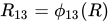
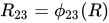
where R12=ϕ12(R){displaystyle R_{12}=phi _{12}(R)}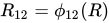



- ϕ12(a⊗b)=a⊗b⊗1,{displaystyle phi _{12}(aotimes b)=aotimes botimes 1,}

- ϕ13(a⊗b)=a⊗1⊗b,{displaystyle phi _{13}(aotimes b)=aotimes 1otimes b,}

- ϕ23(a⊗b)=1⊗a⊗b.{displaystyle phi _{23}(aotimes b)=1otimes aotimes b.}

R is called the R-matrix.
As a consequence of the properties of quasitriangularity, the R-matrix, R, is a solution of the Yang-Baxter equation (and so a module V of H can be used to determine quasi-invariants of braids, knots and links). Also as a consequence of the properties of quasitriangularity, (ϵ⊗1)R=(1⊗ϵ)R=1∈H{displaystyle (epsilon otimes 1)R=(1otimes epsilon )R=1in H}
R−1=(S⊗1)(R){displaystyle R^{-1}=(Sotimes 1)(R)}


antipode S must be a linear isomorphism, and thus S2 is an automorphism. In fact, S2 is given by conjugating by an invertible element: S2(x)=uxu−1{displaystyle S^{2}(x)=uxu^{-1}}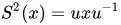

It is possible to construct a quasitriangular Hopf algebra from a Hopf algebra and its dual, using the Drinfeld quantum double construction.
If the Hopf algebra H is quasitriangular, then the category of modules over H is braided with braiding
cU,V(u⊗v)=T(R⋅(u⊗v))=T(R1u⊗R2v){displaystyle c_{U,V}(uotimes v)=Tleft(Rcdot (uotimes v)right)=Tleft(R_{1}uotimes R_{2}vright)}.
Contents
1 Twisting
2 See also
3 Notes
4 References
Twisting
The property of being a quasi-triangular Hopf algebra is preserved by twisting via an invertible element F=∑ifi⊗fi∈A⊗A{displaystyle F=sum _{i}f^{i}otimes f_{i}in {mathcal {Aotimes A}}}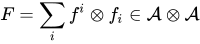

- (F⊗1)∘(Δ⊗id)F=(1⊗F)∘(id⊗Δ)F{displaystyle (Fotimes 1)circ (Delta otimes id)F=(1otimes F)circ (idotimes Delta )F}

Furthermore, u=∑ifiS(fi){displaystyle u=sum _{i}f^{i}S(f_{i})}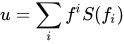

See also
- Quasi-triangular quasi-Hopf algebra
- Ribbon Hopf algebra
Notes
^ Montgomery & Schneider (2002), p. 72.
References
Montgomery, Susan (1993). Hopf algebras and their actions on rings. Regional Conference Series in Mathematics. 82. Providence, RI: American Mathematical Society. ISBN 0-8218-0738-2. Zbl 0793.16029..mw-parser-output cite.citation{font-style:inherit}.mw-parser-output .citation q{quotes:"""""""'""'"}.mw-parser-output .citation .cs1-lock-free a{background:url("//upload.wikimedia.org/wikipedia/commons/thumb/6/65/Lock-green.svg/9px-Lock-green.svg.png")no-repeat;background-position:right .1em center}.mw-parser-output .citation .cs1-lock-limited a,.mw-parser-output .citation .cs1-lock-registration a{background:url("//upload.wikimedia.org/wikipedia/commons/thumb/d/d6/Lock-gray-alt-2.svg/9px-Lock-gray-alt-2.svg.png")no-repeat;background-position:right .1em center}.mw-parser-output .citation .cs1-lock-subscription a{background:url("//upload.wikimedia.org/wikipedia/commons/thumb/a/aa/Lock-red-alt-2.svg/9px-Lock-red-alt-2.svg.png")no-repeat;background-position:right .1em center}.mw-parser-output .cs1-subscription,.mw-parser-output .cs1-registration{color:#555}.mw-parser-output .cs1-subscription span,.mw-parser-output .cs1-registration span{border-bottom:1px dotted;cursor:help}.mw-parser-output .cs1-ws-icon a{background:url("//upload.wikimedia.org/wikipedia/commons/thumb/4/4c/Wikisource-logo.svg/12px-Wikisource-logo.svg.png")no-repeat;background-position:right .1em center}.mw-parser-output code.cs1-code{color:inherit;background:inherit;border:inherit;padding:inherit}.mw-parser-output .cs1-hidden-error{display:none;font-size:100%}.mw-parser-output .cs1-visible-error{font-size:100%}.mw-parser-output .cs1-maint{display:none;color:#33aa33;margin-left:0.3em}.mw-parser-output .cs1-subscription,.mw-parser-output .cs1-registration,.mw-parser-output .cs1-format{font-size:95%}.mw-parser-output .cs1-kern-left,.mw-parser-output .cs1-kern-wl-left{padding-left:0.2em}.mw-parser-output .cs1-kern-right,.mw-parser-output .cs1-kern-wl-right{padding-right:0.2em}
Montgomery, Susan; Schneider, Hans-Jürgen (2002). New directions in Hopf algebras. Mathematical Sciences Research Institute Publications. 43. Cambridge University Press. ISBN 978-0-521-81512-3. Zbl 0990.00022.


