Blechnoideae
| Blechnoideae | |
|---|---|
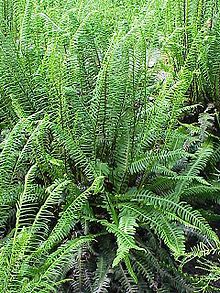 | |
Blechnum spicant | |
Scientific classification | |
| Kingdom: | Plantae |
| (unranked): | Polypodiophyta |
| Subclass: | Polypodiidae |
| Order: | Polypodiales |
| Family: | Aspleniaceae |
| Subfamily: | Blechnoideae Hook |
Type genus | |
Blechnum | |
| Genera | |
See text | |
Blechnoideae is a subfamily of between 240 and 260 species of ferns, with a cosmopolitan distribution.
Contents
1 Description
2 Taxonomy
2.1 Earlier classifications
2.2 Christenhusz and Chase classification
2.3 Subdivision
3 References
4 Bibliography
5 External links
Description
Most are ground dwelling, some are climbers, such as Stenochlaena. A characteristic feature of many species is that the young opening fronds are usually tinged with red.
Taxonomy
Earlier classifications
Previously treated as a separate family, Blechnaceae Newman,[1][2] in 2014 Christenhusz and Chase submerged it as subfamily Blechnoideae within family Aspleniaceae.[3]
Originally considered as a member of the Eupolypods II clade, in the order Polypodiales,[4] in the class Polypodiopsida.[2] the Blechnaceae was related to other families in the clade as in this cladogram:[5][4].mw-parser-output table.clade{border-spacing:0;margin:0;font-size:100%;line-height:100%;border-collapse:separate;width:auto}.mw-parser-output table.clade table.clade{width:100%}.mw-parser-output table.clade td{border:0;padding:0;vertical-align:middle;text-align:center}.mw-parser-output table.clade td.clade-label{width:0.8em;border:0;padding:0 0.2em;vertical-align:bottom;text-align:center}.mw-parser-output table.clade td.clade-slabel{border:0;padding:0 0.2em;vertical-align:top;text-align:center}.mw-parser-output table.clade td.clade-bar{vertical-align:middle;text-align:left;padding:0 0.5em}.mw-parser-output table.clade td.clade-leaf{border:0;padding:0;text-align:left;vertical-align:middle}.mw-parser-output table.clade td.clade-leafR{border:0;padding:0;text-align:right}
eupolypods II |
| ||||||||||||||||||||||||||||||||||||||||||||||||||||||
| |
Christenhusz and Chase classification
Blechnoideae is placed within the Aspleniaceae as follows:[3]
Aspleniaceae |
| ||||||||||||||||||||||||||||||||||||||||||
| |
Subdivision
The number of genera recognized within Blechnoideae (Blechnaceae) varies greatly between authors,[1][6][7] but has generally been between eight and ten. Of the approximate 200 species, the vast majority are attributed to Blechnum L., followed by Woodwardia Sm. with about 14 species, and Stenochlaena J.Sm. with six. Other genera are largely monotypic.[8]
Anchistea C.Presl. 1851
Austroblechnum Gasper & V.A.O.Dittrich 2016
Blechnidium T.Moore 1860
Blechnopsis C.Presl. 1851
Blechnum L. 1753 – hard ferns
Brainea J.Sm. 1856
Cleistoblechnum Gasper & Salino 2016
Cranfillia Gasper & V.A.O.Dittrich 2016
Diploblechnum Hayata 1927
Doodia R.Br. 1810
Icarus Gasper & Solino 2016
Lomaria Willd. 1809
Lomaridium C.Presl. 1851
Lomariocycas (J.Sm.) Gasper & A.R.Sm. 2016
Lorinseria C.Presl. 1851
Neoblechnum Gasper & V.A.O.Dittrich 2016
Oceaniopteris Gasper & Salino 2016
Parablechnum C.Presl. 1851
Sadleria Kaulf. 1824
Salpichlaena J.Sm. 1841
Stenochlaena J.Sm. 1841
Struthiopteris Scop. 1760
Telmatoblechnum Perrie 2014
Woodwardia Sm. 1793
Christenhusz and Chase (2014) describe the situation as follows: "Blechnoideae comprise three major clades, one corresponding to Onoclea sensu lato, a second corresponding to Woodwardia, sister to all other species that
can be treated as the single genus Blechnum. However, the subclade sister to the rest of Blechnum sensu lato contains the vining taxa Stenochlaena, Salpichlaena J.Sm. and a few non-vining Blechnum species with long-creeping rhizomes, which may have to be accepted at the generic level pending further studies. Brainea, Doodia, Pteridoblechnum and Sadleria belong to Blechnum sensu lato."[3]
Perrie et al. (2014) simultaneously identified three major clades, which they labelled Woodwardia, super-
Stenochlaena and super-Blechnum, with the latter two as sister groups. They retained the family rank and excluded Onoclea as a separate family, Onocleaceae as sister to Blechnaceae. They did not consider Blechnum as monophyletic and recommended revision of intergeneric boundaries, resulting in seven genera.[8]
Gasper et al. (2016), independently of Christenhusz and Chase examined the deeper relationships of the
Blechnoideae, while retaining its family status and excluding Onocleaceae, and allocated these clades to subfamilies, Blechnoideae, Woodwardioideae, and Stenochlaenoideae respectively. Their approach to the polyphyletic nature of Blechnum was to create a series of monophyletic segregate genera, resulting in 24 genera in total. If Blechnoideae is considered a subfamily sensu Christenhusz and Chase these would more properly be considered as tribes.[6][7] But the latter treat the Blechnoideae as only three genera. Blechnum sensu lato (including Stenochlaena), Woodwardia and Onoclea sensu lato (including Matteuccia Tod., Onocleopsis F.Ballard and Pentarhizidium Hayata), while conceding the possibility of treating Blechnum as two sister genera, Blechnum (including Brainea, Doodia, Pteridoblechnum and Sadleria) and Stenochlaena.
Their clades are related as follows:
| Blechnoideae |
| ||||||||||||
| |
References
^ ab Maarten J. M. Christenhusz; Xian-Chun Zhang & Harald Schneider (2011). "A linear sequence of extant families and genera of lycophytes and ferns" (PDF). Phytotaxa. 19: 7–54..mw-parser-output cite.citation{font-style:inherit}.mw-parser-output .citation q{quotes:"""""""'""'"}.mw-parser-output .citation .cs1-lock-free a{background:url("//upload.wikimedia.org/wikipedia/commons/thumb/6/65/Lock-green.svg/9px-Lock-green.svg.png")no-repeat;background-position:right .1em center}.mw-parser-output .citation .cs1-lock-limited a,.mw-parser-output .citation .cs1-lock-registration a{background:url("//upload.wikimedia.org/wikipedia/commons/thumb/d/d6/Lock-gray-alt-2.svg/9px-Lock-gray-alt-2.svg.png")no-repeat;background-position:right .1em center}.mw-parser-output .citation .cs1-lock-subscription a{background:url("//upload.wikimedia.org/wikipedia/commons/thumb/a/aa/Lock-red-alt-2.svg/9px-Lock-red-alt-2.svg.png")no-repeat;background-position:right .1em center}.mw-parser-output .cs1-subscription,.mw-parser-output .cs1-registration{color:#555}.mw-parser-output .cs1-subscription span,.mw-parser-output .cs1-registration span{border-bottom:1px dotted;cursor:help}.mw-parser-output .cs1-ws-icon a{background:url("//upload.wikimedia.org/wikipedia/commons/thumb/4/4c/Wikisource-logo.svg/12px-Wikisource-logo.svg.png")no-repeat;background-position:right .1em center}.mw-parser-output code.cs1-code{color:inherit;background:inherit;border:inherit;padding:inherit}.mw-parser-output .cs1-hidden-error{display:none;font-size:100%}.mw-parser-output .cs1-visible-error{font-size:100%}.mw-parser-output .cs1-maint{display:none;color:#33aa33;margin-left:0.3em}.mw-parser-output .cs1-subscription,.mw-parser-output .cs1-registration,.mw-parser-output .cs1-format{font-size:95%}.mw-parser-output .cs1-kern-left,.mw-parser-output .cs1-kern-wl-left{padding-left:0.2em}.mw-parser-output .cs1-kern-right,.mw-parser-output .cs1-kern-wl-right{padding-right:0.2em}
^ ab Smith et al 2006.
^ abc Christenhusz & Chase 2014.
^ ab Carl J. Rothfels; Anders Larsson; Li-Yaung Kuo; Petra Korall; Wen- Liang Chiou; Kathleen M. Pryer (2012). "Overcoming Deep Roots, Fast Rates, and Short Internodes to Resolve the Ancient Rapid Radiation of Eupolypod II Ferns". Systematic Biology. 61 (1): 490–509. doi:10.1093/sysbio/sys001. PMID 22223449.
^ Samuli Lehtonen (2011). Steinke, Dirk, ed. "Towards Resolving the Complete Fern Tree of Life" (PDF). PLoS ONE. 6 (10): e24851. doi:10.1371/journal.pone.0024851. PMC 3192703. PMID 22022365.
^ ab Gasper et al 2016.
^ ab Gasper et al 2016a.
^ ab Perrie et al 2014.
Bibliography
.mw-parser-output .refbegin{font-size:90%;margin-bottom:0.5em}.mw-parser-output .refbegin-hanging-indents>ul{list-style-type:none;margin-left:0}.mw-parser-output .refbegin-hanging-indents>ul>li,.mw-parser-output .refbegin-hanging-indents>dl>dd{margin-left:0;padding-left:3.2em;text-indent:-3.2em;list-style:none}.mw-parser-output .refbegin-100{font-size:100%}
Christenhusz, Maarten J.M. & Chase, Mark W. (2014). "Trends and concepts in fern classification". Annals of Botany. 113 (9): 571–594. doi:10.1093/aob/mct299. PMC 3936591. PMID 24532607.
Gasper, André Luís de; Dittrich, Vinícius Antonio de Oliveira; Smith, Alan Reid; Salino, Alexandre (21 September 2016). "A classification for Blechnaceae (Polypodiales: Polypodiopsida): New genera, resurrected names, and combinations". Phytotaxa. 275 (3): 191. doi:10.11646/phytotaxa.275.3.1.
de Gasper, André L.; Almeida, Thaís E.; Dittrich, Vinícius A. de O.; Smith, Alan R.; Salino, Alexandre (October 2016). "Molecular phylogeny of the fern family Blechnaceae (Polypodiales) with a revised genus-level treatment" (PDF). Cladistics. doi:10.1111/cla.12173.
Perrie, Leon R.; Wilson, Ruby K.; Shepherd, Lara D.; Ohlsen, Daniel J.; Batty, Erin L.; Brownsey, Patrick J.; Bayly, Michael J. (28 August 2014). "Molecular phylogenetics and generic taxonomy of Blechnaceae ferns". Taxon. 63 (4): 745–758. doi:10.12705/634.13.
Smith, Alan R.; Pryer, Kathleen M.; Schuettpelz, Eric; Korall, Petra; Schneider, Harald; Wolf, Paul G. (1 January 2006). "A Classification for Extant Ferns" (PDF). Taxon. 55 (3): 705–731. doi:10.2307/25065646. JSTOR 25065646.
External links
- Germplasm Resources Information Network: Blechnaceae


