400 metres hurdles
Athletics 400 metres hurdles | |
|---|---|
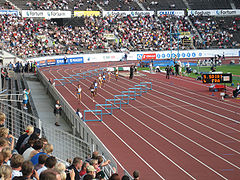 Women's 400m hurdles. | |
| Men's records | |
| World |  Kevin Young 46.78 (1992) Kevin Young 46.78 (1992) |
| Olympic | Kevin Young 46.78 (1992) |
| Women's records | |
| World |  Yuliya Pechonkina 52.34 (2003) Yuliya Pechonkina 52.34 (2003) |
| Olympic |  Melaine Walker 52.64 (2008) Melaine Walker 52.64 (2008) |
The 400 metres hurdles is a track and field hurdling event. The event has been on the Olympic athletics programme since 1900 for men and since 1984 for women.
On a standard outdoor track, 400 metres is the length of the inside lane, once around the stadium. Runners stay in their lanes the entire way after starting out of the blocks and must clear ten hurdles that are evenly spaced around the track. The hurdles are positioned and weighted so that they fall forward if bumped into with sufficient force, to prevent injury to the runners. Although there is no longer any penalty for knocking hurdles over, runners prefer to clear them cleanly, as touching them during the race slows runners down.
The best male athletes can run the 400 m hurdles in a time of around 47 seconds, while the best female athletes achieve a time of around 53 seconds. The current men's and women's world record holders are Kevin Young with 46.78 seconds and Yuliya Pechonkina with 52.34 seconds. Compared to the 400 metres run, the hurdles race takes the men about three seconds longer and the women four seconds longer.
The 400 m hurdles was held for both sexes at the inaugural IAAF World Championships in Athletics. The first championship for women came at the 1980 World Championships in Athletics – being held as a one-off due to the lack of a race at the 1980 Summer Olympics.
Contents
1 History
2 Hurdling technique
2.1 Block start
2.2 Hurdling
2.3 Stride length
3 All-time top 25 hurdlers
3.1 Men
3.1.1 Notes
3.2 Women
3.2.1 Notes
4 Milestones
5 Most successful athletes
6 Olympic medalists
6.1 Men
6.2 Women
7 World Championships medalists
7.1 Men
7.2 Women
8 Season's bests
9 External links
10 Notes and references
History
The first awards in a 400 m hurdles race were given in 1860 when a race was held in Oxford, England, over a course of 440 yards (402.336 m). While running the course, participants had to clear twelve wooden hurdles, over 100 centimetres tall, that had been spaced in even intervals.
To reduce the risk of injury, somewhat more lightweight constructions were introduced in 1895 that runners could push over. However, until 1935 runners were disqualified if they pushed over more than three hurdles in a race and records were only officially accepted if the runner in question had cleared all hurdles clean and left them all standing.
The 400 m hurdles became an Olympic event at the 1900 Summer Olympics in Paris, France. At the same time, the race was standardized so that virtually identical races could be held and the finish times compared to each other. As a result, the official distance was fixed to 400 metres, or one lap of the stadium, and the number of hurdles was reduced to ten. The official height of the hurdles was set to 91.4 cm (3 feet) for men and 76.20 cm (2 ft, 6 inches) for women. The hurdles were now placed on the course with a run-up to the first hurdle of 45 metres, a distance between the hurdles of 35 metres each, and a home stretch from the last hurdle to the finish line of 40 metres.
The first documented 400 m hurdles race for women took place in 1971. The International Association of Athletics Federations (IAAF) introduced the event officially as a discipline in 1974, although it was not run at the Olympics until 1984, the first Men's World Champion having been crowned the year before at the inaugural IAAF World Championships in Athletics. A special edition of the Women's 400m Hurdles happened in the 1980 IAAF World Championships in Athletics in response to the Women's 400m Hurdles not being included in the boycotted 1980 Moscow Olympics and the Liberty Bell Classic.
Many athletic commentators and officials have often brought up the idea of lifting the height of the women's 400 m hurdles to incorporate a greater requirement of hurdling skill. This is a view held by German athletic coach Norbert Stein: "All this means that the women's hurdles for specialists, who are the target group to be dealt with in this discussion, is considerably depreciated in skill demands when compared to the men's hurdles. It should not be possible in the women's hurdles that the winner is an athlete whose performance in the flat sprint is demonstrably excellent but whose technique of hurdling is only moderate and whose anthropometric characteristics are not optimal. This was the case at the World Championships in Seville and the same problem can often be seen at international and national meetings."[citation needed]
Hurdling technique
"The 400m hurdle race one of the most demanding of all events in the sprint-hurdle group." (Lindeman) It requires speed, endurance, and hurdling technique all along with unique awareness and special concentration throughout the race.
Block start
When preparing to hurdle, the blocks should be set so that the athlete arrives at the first hurdle leading on the desired leg without inserting a stutter step. A stutter step is when the runner has to chop his or her stride down to arrive on the "correct" leg for take off. Throughout the race, any adjustments to stride length stride speed should be made several strides out from the hurdle because a stutter or being too far from the hurdle at take off will result in loss of momentum and speed.
Hurdling
At the beginning of the take-off, the knee must be driven toward the hurdle and the foot then extended. The leg position when extended must be stretched out, in a position of a split. The knee should be slightly bent when crossing the hurdle. Unless an athlete's body has great flexibility, the knee must be slightly bent to allow a forward body lean. Unlike the 110m hurdles, a significant forward body lean is not that necessary due to the hurdles being lower. However, the trail leg must be kept bent and short to provide a quick lever action allowing a fast hurdle clearance. The knee should pull through under the armpit and should not be flat across the top of the hurdle.
It is also important that the hurdler doesn't reach out on the last stride before the hurdle as this will result in a longer bound being made to clear the hurdle. This will also result in a loss of momentum if the foot lands well in front of the center of gravity.
Stride length
Using a left lead leg on the bends allows the hurdler to run closer to the inside of the lane and cover a shorter distance. Additionally, if the left leg is used for the lead, then the athlete's upper body can be leaned to the left, making it easier to bring the trail leg through. Additionally, an athlete hurdling with a right leg lead around the bends must take care that they do not inadvertently trail their foot or toe around the hurdle rather than passing over the top, which would lead to a disqualification from the race. Depending on the height and strength of the athlete, men work toward a stride pattern of 13 to 15 steps between each hurdle, and women work toward a stride pattern of 15 to 17. This does not include the landing step from the previous hurdle. Weaker athletes will typically hold a longer step pattern throughout the race so that they do not bound or reach with each step, which also results in a loss of speed. These patterns are ideal because it allows the hurdler to take off from their predominant leg throughout the race without switching legs. However, fatigue from the race will knock athletes of their stride pattern and force runners to switch legs. At an early age, many coaches train their athletes to hurdle with both legs. This is a useful skill to learn since as a runner tires, their stride length may decrease, resulting in the need either to add a stutter stride, or to take a hurdle on the other leg.
The 400 metre hurdles is a very physically demanding race. It requires intense training to get the endurance, speed and technique needed to compete.
All-time top 25 hurdlers
Men
As of August 2018[1]
| Rank | Time | Athlete | Country | Date | Venue | Ref |
|---|---|---|---|---|---|---|
| 1 | 46.78 | Kevin Young | United States | 6 August 1992 | Barcelona | |
| 2 | 46.98 | Abderrahman Samba |  Qatar Qatar | 30 June 2018 | Paris | [2] |
| 3 | 47.02 | Edwin Moses | United States | 31 August 1983 | Koblenz | |
Rai Benjamin |  Antigua and Barbuda Antigua and Barbuda | 8 June 2018 | Eugene | [3] | ||
| 5 | 47.03 | Bryan Bronson | United States | 21 June 1998 | New Orleans | |
| 6 | 47.10 | Samuel Matete |  Zambia Zambia | 7 August 1991 | Zürich | |
| 7 | 47.19 | Andre Phillips | United States | 25 September 1988 | Seoul | |
| 8 | 47.23 | Amadou Dia Ba |  Senegal Senegal | 25 September 1988 | Seoul | |
| 9 | 47.24 | Kerron Clement | United States | 26 June 2005 | Carson, California | |
| 10 | 47.25 | Félix Sánchez |  Dominican Republic Dominican Republic | 29 August 2003 | Paris, Saint-Denis | |
| Angelo Taylor | United States | 18 August 2008 | Beijing | |||
| 12 | 47.30 | Bershawn Jackson | United States | 9 August 2005 | Helsinki | |
| 13 | 47.37 | Stéphane Diagana |  France France | 5 July 1995 | Lausanne | |
| 14 | 47.38 | Danny Harris | United States | 10 July 1991 | Lausanne | |
| 15 | 47.43 | James Carter | United States | 9 August 2005 | Helsinki | |
| 16 | 47.48 | Harald Schmid |  West Germany West Germany | 8 September 1982 | Athens | |
| 17 | 47.53 | Hadi Soua'an Al-Somaily |  Saudi Arabia Saudi Arabia | 27 September 2000 | Sydney | |
| 18 | 47.54 | Derrick Adkins | United States | 5 July 1995 | Lausanne | |
| Fabrizio Mori |  Italy Italy | 10 August 2001 | Edmonton | |||
Kyron McMaster |  British Virgin Islands British Virgin Islands | 30 June 2018 | Paris | [4] | ||
| 21 | 47.60 | Winthrop Graham | Jamaica | 4 August 1993 | Zürich | |
| 22 | 47.63 | Johnny Dutch | United States | 26 June 2010 | Des Moines | |
| 23 | 47.64 | Karsten Warholm |  Norway Norway | 9 August 2018 | Berlin | [5] |
| 24 | 47.66 A | L. J. van Zyl |  South Africa South Africa | 25 February 2011 | Pretoria | |
| 47.66 | 31 May 2011 | Ostrava | ||||
| 25 | 47.67 | Bennie Brazell | United States | 11 June 2005 | Sacramento |
Notes
Below is a list of all other times superior to 47.35:
Edwin Moses ran 47.13 (1980), 47.14 (1981), 47.17 (1980), 47.27 (1981), 47.32 (1984)
Kevin Young ran 47.18 (1993)
Bershawn Jackson ran 47.32 (2010)
Felix Sanchez ran 47.35 (2002)
Women
As of May 2018[6]
| Rank | Time | Athlete | Nation | Date | Place | Ref |
|---|---|---|---|---|---|---|
| 1 | 52.34 | Yuliya Pechonkina | Russia | 8 August 2003 | Tula | |
| 2 | 52.42 | Melaine Walker | Jamaica | 20 August 2009 | Berlin | |
| 3 | 52.47 | Lashinda Demus | United States | 1 September 2011 | Daegu | |
| 4 | 52.61 | Kim Batten | United States | 11 August 1995 | Gothenburg | |
| 5 | 52.62 | Tonja Buford-Bailey | United States | 11 August 1995 | Gothenburg | |
| 6 | 52.64 | Dalilah Muhammad | United States | 25 June 2017 | Sacramento | [7] |
| 7 | 52.70 | Natalya Antyukh | Russia | 8 August 2012 | London | [8] |
| 8 | 52.74 | Sally Gunnell |  Great Britain Great Britain | 19 August 1993 | Stuttgart | |
| 9 | 52.75 | Shamier Little | United States | 25 June 2017 | Sacramento | [9] |
Sydney McLaughlin | United States | 13 May 2018 | Knoxville | [10] | ||
| 11 | 52.77 | Fani Halkia |  Greece Greece | 22 August 2004 | Athens | |
| 12 | 52.79 | Sandra Farmer-Patrick | United States | 19 August 1993 | Stuttgart | |
| Kaliese Spencer | Jamaica | 5 August 2011 | London | |||
| 14 | 52.82 | Deon Hemmings | Jamaica | 31 July 1996 | Atlanta | |
| 15 | 52.83 | Zuzana Hejnová |  Czech Republic Czech Republic | 15 August 2013 | Moscow | |
| 16 | 52.89 | Daimí Pernía |  Cuba Cuba | 25 August 1999 | Seville | |
| 17 | 52.90 | Nezha Bidouane |  Morocco Morocco | 25 August 1999 | Seville | |
| 18 | 52.94 | Marina Stepanova |  Soviet Union Soviet Union | 17 September 1986 | Tashkent | |
| 19 | 52.95 | Sheena Johnson | United States | 11 July 2004 | Sacramento | |
Kori Carter | United States | 25 June 2017 | Sacramento | [11] | ||
| 21 | 53.02 | Irina Privalova | Russia | 27 September 2000 | Sydney | |
| 22 | 53.11 | Tatyana Ledovskaya | Soviet Union | 29 August 1991 | Tokyo | |
Ashley Spencer | United States | 25 June 2017 | Sacramento | [12] | ||
| 24 | 53.14 | Georganne Moline | United States | 25 June 2017 | Sacramento | [13] |
| 25 | 53.17 | Debbie Flintoff-King |  Australia Australia | 28 September 1988 | Seoul |
Notes
Below is a list of all other times superior to 52.88.
Lashinda Demus ran 52.63 (2009), 52.77 (2012), 52.82 (2010).
Melaine Walker ran 52.64 (2008), 52.73 (2011).
Kim Batten ran 52.74 (1998), 52.84 (1998).
Faní Halkiá also ran 52.82 (2004).
Dalilah Muhammad also ran 52.88 (2016).
Milestones
- Men
- First official IAAF world record: 55.0 seconds, Charles Bacon (USA), 1908
- First under 54 seconds: 53.8 seconds, Sten Pettersson (SWE), 1925
- First under 53 seconds: 52.6 seconds, John Gibson (USA), 1927
- First under 52 seconds: 51.7 seconds, Bob Tisdall (IRL), 1932
- First under 51 seconds: 50.6 seconds, Glenn Hardin (USA), 1934
- First under 50 seconds: 49.5 seconds, Glenn Davis (USA), 1956
- First under 49 seconds: 48.8 seconds, Geoff Vanderstock (USA), 1968
- First under 48 seconds: 47.82 seconds, John Akii-Bua (UGA), 1972
- First under 47 seconds: 46.78 seconds, Kevin Young (USA), 1992
- Women
- First official world record: 56.51 seconds, Krystyna Kacperczyk (POL), 1974
- First under 56 seconds: 55.74 seconds, Tatjana Storoschewa (USSR), 1977
- First under 55 seconds: 54.89 seconds, Tatjana Selenzowa (USSR), 1978
- First under 54 seconds: 53.58 seconds, Margarita Ponomaryova (USSR), 1984
- First under 53 seconds: 52.94 seconds, Marina Stepanova (USSR), 1986
Most successful athletes
American athlete Glenn Davis had a prodigious start to his hurdling career, running his first race in April 1956 in 54.4 s. Two months later, he ran a new world record with 49.5 s and later that year he won the 400 m hurdles at the Olympics, and was also the first to repeat that feat in 1960.
In terms of success and longevity in competition, Edwin Moses' record is significant: he won 122 races in a row between 1977 and 1987 plus two gold medals, at the 1976 Summer Olympics in Montréal and the 1984 Summer Olympics in Los Angeles. He was undefeated for exactly nine years nine months and nine days, from 26 August 1977 until 4 June 1987. The U.S. boycott of the 1980 Summer Olympics in Moscow prevented him from winning a hat-trick of gold medals, but his career is nonetheless widely regarded as one of the most successful in hurdling. He finished third in the 1988 Olympic final, the last race in his professional career. He also held the world record for sixteen years from when he first broke it at the Olympics on 25 July 1976 (twice in one day) until it was finally broken by Kevin Young at the 1992 Summer Olympics in Barcelona.

Olympic Games & World Championships victories
Edwin Moses (USA), Olympic 1976, 1984, World 1983, 1987
Felix Sanchez (DOM), Olympic 2004, 2012, World 2001, 2003
Kerron Clement (USA), Olympic 2016 (and Olympic silver 2008), World 2007 and 2009
Sally Gunnell (GBR), Olympic 1992, World 1993
Kevin Young (USA), Olympic 1992, World 1993
Derrick Adkins (USA), Olympic 1996, World 1995
Melaine Walker (JAM), Olympic 2008, World 2009
Two Olympic victories:
Glenn Davis (USA), 1956 and 1960
Edwin Moses (USA), 1976 and 1984 (also bronze in 1988)
Angelo Taylor (USA), 2000 and 2008
Félix Sánchez (DOM), 2004 and 2012
Two World Championships:
Edwin Moses (USA), 1983 and 1987
Félix Sánchez (DOM), 2001 and 2003 (won silver in 2007)
Kerron Clement (USA), 2007 and 2009
Nezha Bidouane (MAR), 1997 and 2001 (won silver in 1999)
Jana Rawlinson (AUS), 2003 (as Jana Pittman) and 2007
Zuzana Hejnová (CZE), 2013 and 2015
- Note: Edwin Moses and Kevin Young are the only male 400 m hurdlers to have been Olympic Champion, World Champion and broken the World Record.
- Note: Sally Gunnell is the only female 400 m hurdler to have been Olympic Champion, World Champion and broken the World Record.
Olympic medalists
Men
| Games | Gold | Silver | Bronze |
|---|---|---|---|
1900 Paris | Walter Tewksbury  United States United States | Henri Tauzin France | George Orton  Canada Canada |
1904 St. Louis | Harry Hillman United States | Frank Waller United States | George Poage United States |
1908 London | Charles Bacon United States | Harry Hillman United States | Jimmy Tremeer Great Britain |
| 1912 Stockholm | not included in the Olympic program | ||
1920 Antwerp | Frank Loomis  United States United States | John Norton United States | August Desch United States |
1924 Paris | Morgan Taylor United States | Erik Wilén  Finland Finland | Ivan Riley United States |
1928 Amsterdam | David Burghley Great Britain | Frank Cuhel United States | Morgan Taylor United States |
1932 Los Angeles | Bob Tisdall  Ireland Ireland | Glenn Hardin United States | Morgan Taylor United States |
1936 Berlin | Glenn Hardin United States | John Loaring  Canada Canada | Miguel White  Philippines Philippines |
1948 London | Roy Cochran United States | Duncan White  Ceylon Ceylon | Rune Larsson  Sweden Sweden |
1952 Helsinki | Charles Moore United States | Yuriy Lituyev  Soviet Union Soviet Union | John Holland  New Zealand New Zealand |
1956 Melbourne | Glenn Davis United States | Eddie Southern United States | Josh Culbreath United States |
1960 Rome | Glenn Davis  United States United States | Clifton Cushman United States | Dick Howard United States |
1964 Tokyo | Rex Cawley United States | John Cooper Great Britain | Salvatore Morale Italy |
1968 Mexico City | David Hemery Great Britain | Gerhard Hennige  West Germany West Germany | John Sherwood Great Britain |
1972 Munich | John Akii-Bua  Uganda Uganda | Ralph Mann United States | David Hemery Great Britain |
1976 Montreal | Edwin Moses United States | Michael Shine United States | Yevgeniy Gavrilenko  Soviet Union Soviet Union |
1980 Moscow | Volker Beck  East Germany East Germany | Vasyl Arkhypenko Soviet Union | Gary Oakes  Great Britain Great Britain |
1984 Los Angeles | Edwin Moses United States | Danny Harris United States | Harald Schmid West Germany |
1988 Seoul | André Phillips United States | Amadou Dia Ba Senegal | Edwin Moses United States |
1992 Barcelona | Kevin Young United States | Winthrop Graham Jamaica | Kriss Akabusi Great Britain |
1996 Atlanta | Derrick Adkins United States | Samuel Matete  Zambia Zambia | Calvin Davis United States |
2000 Sydney | Angelo Taylor United States | Hadi Al-Somaily Saudi Arabia | Llewellyn Herbert South Africa |
2004 Athens | Félix Sánchez Dominican Republic | Danny McFarlane Jamaica | Naman Keïta France |
2008 Beijing | Angelo Taylor United States | Kerron Clement United States | Bershawn Jackson United States |
2012 London | Félix Sánchez Dominican Republic | Michael Tinsley United States | Javier Culson  Puerto Rico Puerto Rico |
2016 Rio de Janeiro | Kerron Clement United States | Boniface Mucheru Tumuti  Kenya Kenya | Yasmani Copello  Turkey Turkey |
Women
| Games | Gold | Silver | Bronze |
|---|---|---|---|
1984 Los Angeles | Nawal El Moutawakel Morocco | Judi Brown United States | Cristieana Cojocaru  Romania Romania |
1988 Seoul | Debbie Flintoff-King Australia | Tatyana Ledovskaya Soviet Union | Ellen Fiedler East Germany |
1992 Barcelona | Sally Gunnell Great Britain | Sandra Farmer-Patrick United States | Janeene Vickers United States |
1996 Atlanta | Deon Hemmings Jamaica | Kim Batten United States | Tonja Buford-Bailey United States |
2000 Sydney | Irina Privalova Russia | Deon Hemmings Jamaica | Nezha Bidouane Morocco |
2004 Athens | Fani Halkia Greece | Ionela Târlea-Manolache  Romania Romania | Tetyana Tereshchuk-Antipova  Ukraine Ukraine |
2008 Beijing | Melaine Walker Jamaica | Sheena Tosta United States | Tasha Danvers Great Britain |
2012 London | Natalya Antyukh Russia | Lashinda Demus United States | Zuzana Hejnová Czech Republic |
2016 Rio de Janeiro | Dalilah Muhammad United States | Sara Petersen  Denmark Denmark | Ashley Spencer United States |
World Championships medalists
Men
| Championships | Gold | Silver | Bronze |
|---|---|---|---|
1983 Helsinki | Edwin Moses (USA) | Harald Schmid (FRG) | Aleksandr Kharlov (URS) |
1987 Rome | Edwin Moses (USA) | Danny Harris (USA) | Harald Schmid (FRG) |
1991 Tokyo | Samuel Matete (ZAM) | Winthrop Graham (JAM) | Kriss Akabusi (GBR) |
1993 Stuttgart | Kevin Young (USA) | Samuel Matete (ZAM) | Winthrop Graham (JAM) |
1995 Gothenburg | Derrick Adkins (USA) | Samuel Matete (ZAM) | Stéphane Diagana (FRA) |
1997 Athens | Stéphane Diagana (FRA) | Llewellyn Herbert (RSA) | Bryan Bronson (USA) |
1999 Seville | Fabrizio Mori (ITA) | Stéphane Diagana (FRA) |  Marcel Schelbert (SUI) Marcel Schelbert (SUI) |
2001 Edmonton | Félix Sánchez (DOM) | Fabrizio Mori (ITA) |  Dai Tamesue (JPN) Dai Tamesue (JPN) |
2003 Saint-Denis | Félix Sánchez (DOM) | Joey Woody (USA) | Periklis Iakovakis (GRE) |
2005 Helsinki | Bershawn Jackson (USA) | James Carter (USA) | Dai Tamesue (JPN) |
2007 Osaka | Kerron Clement (USA) | Félix Sánchez (DOM) |  Marek Plawgo (POL) Marek Plawgo (POL) |
2009 Berlin | Kerron Clement (USA) | Javier Culson (PUR) | Bershawn Jackson (USA) |
2011 Daegu | Dai Greene (GBR) | Javier Culson (PUR) | L. J. van Zyl (RSA) |
2013 Moscow |  Jehue Gordon (TRI) Jehue Gordon (TRI) | Michael Tinsley (USA) |  Emir Bekrić (SRB) Emir Bekrić (SRB) |
2015 Beijing | Nicholas Bett (KEN) | Denis Kudryavtsev (RUS) |  Jeffery Gibson (BAH) Jeffery Gibson (BAH) |
2017 London | Karsten Warholm (NOR) | Yasmani Copello (TUR) | Kerron Clement (USA) |
Women
- The official IAAF World Championships in Athletics began in 1983, but in 1980, the women's 3000 metres and 400 metres hurdles events had a World Championship competition in Sittard, Netherlands. This was due to these events not yet being on the Olympic program (the same had happened in 1976 for the men's 50 km walk).[14]
| Championships | Gold | Silver | Bronze |
|---|---|---|---|
1980 Sittard | Bärbel Broschat (GDR) | Ellen Neumann (GDR) | Petra Pfaff (GDR) |
1983 Helsinki | Yekaterina Fesenko (URS) | Ana Ambrazienė (URS) | Ellen Neumann-Fiedler (GDR) |
1987 Rome | Sabine Busch (GDR) | Debbie Flintoff (AUS) | Cornelia Feuerbach (GDR) |
1991 Tokyo | Tatyana Ledovskaya (URS) | Sally Gunnell (GBR) | Janeene Vickers (USA) |
1993 Stuttgart | Sally Gunnell (GBR) | Sandra Farmer-Patrick (USA) | Margarita Ponomaryova (RUS) |
1995 Gothenburg | Kim Batten (USA) | Tonja Buford (USA) | Deon Hemmings (JAM) |
1997 Athens | Nezha Bidouane (MAR) | Deon Hemmings (JAM) | Kim Batten (USA) |
1999 Seville | Daimí Pernía (CUB) | Nezha Bidouane (MAR) | Deon Hemmings (JAM) |
2001 Edmonton | Nezha Bidouane (MAR) | Yuliya Pechonkina (RUS) | Daimí Pernía (CUB) |
2003 Saint-Denis | Jana Pittman (AUS) | Sandra Glover (USA) | Yuliya Pechonkina (RUS) |
2005 Helsinki | Yuliya Pechonkina (RUS) | Lashinda Demus (USA) | Sandra Glover (USA) |
2007 Osaka | Jana Rawlinson (AUS) | Yuliya Pechenkina (RUS) | Anna Jesień (POL) |
2009 Berlin | Melaine Walker (JAM) | Lashinda Demus (USA) | Josanne Lucas (TRI) |
2011 Daegu | Lashinda Demus (USA) | Melaine Walker (JAM) | Natalya Antyukh (RUS) |
2013 Moscow | Zuzana Hejnová (CZE) | Dalilah Muhammad (USA) | Lashinda Demus (USA) |
2015 Beijing | Zuzana Hejnová (CZE) | Shamier Little (USA) | Cassandra Tate (USA) |
2017 London | Kori Carter (USA) | Dalilah Muhammad (USA) | Ristananna Tracey (JAM) |
Season's bests
|
|
External links
- IAAF list of 400-metres-hurdles records in XML
Notes and references
^ "400 Metres Hurdles Men All Time". IAAF..mw-parser-output cite.citation{font-style:inherit}.mw-parser-output q{quotes:"""""""'""'"}.mw-parser-output code.cs1-code{color:inherit;background:inherit;border:inherit;padding:inherit}.mw-parser-output .cs1-lock-free a{background:url("//upload.wikimedia.org/wikipedia/commons/thumb/6/65/Lock-green.svg/9px-Lock-green.svg.png")no-repeat;background-position:right .1em center}.mw-parser-output .cs1-lock-limited a,.mw-parser-output .cs1-lock-registration a{background:url("//upload.wikimedia.org/wikipedia/commons/thumb/d/d6/Lock-gray-alt-2.svg/9px-Lock-gray-alt-2.svg.png")no-repeat;background-position:right .1em center}.mw-parser-output .cs1-lock-subscription a{background:url("//upload.wikimedia.org/wikipedia/commons/thumb/a/aa/Lock-red-alt-2.svg/9px-Lock-red-alt-2.svg.png")no-repeat;background-position:right .1em center}.mw-parser-output .cs1-subscription,.mw-parser-output .cs1-registration{color:#555}.mw-parser-output .cs1-subscription span,.mw-parser-output .cs1-registration span{border-bottom:1px dotted;cursor:help}.mw-parser-output .cs1-hidden-error{display:none;font-size:100%}.mw-parser-output .cs1-visible-error{font-size:100%}.mw-parser-output .cs1-subscription,.mw-parser-output .cs1-registration,.mw-parser-output .cs1-format{font-size:95%}.mw-parser-output .cs1-kern-left,.mw-parser-output .cs1-kern-wl-left{padding-left:0.2em}.mw-parser-output .cs1-kern-right,.mw-parser-output .cs1-kern-wl-right{padding-right:0.2em}
^ "400m Hurdles Results" (PDF). sportresult.com. 30 June 2018. Retrieved 1 July 2018.
^ Roy Jordan (9 June 2018). "Benjamin and Norman break collegiate records at NCAA Championships". IAAF. Retrieved 13 June 2018.
^ "400m Hurdles Results" (PDF). sportresult.com. 30 June 2018. Retrieved 1 July 2018.
^ "400m Hurdles Men Final Results" (PDF). EAA. 9 August 2018. Retrieved 11 August 2018.
^ "400 Metres Hurdles Women All Time". IAAF.
^ Roy Jordan (25 June 2017). "Muhammad wins historic 400m hurdles race at US Championships". IAAF. Retrieved 26 June 2017.
^ "400 Metres Hurdles Results". IAAF. 8 August 2012. Retrieved 9 August 2012.
^ Roy Jordan (25 June 2017). "Muhammad wins historic 400m hurdles race at US Championships". IAAF. Retrieved 26 June 2017.
^ Jon Mulkeen (14 May 2018). "McLaughlin smashes own world U20 400m hurdles record with 52.75 in Knoxville". IAAF. Retrieved 14 May 2018.
^ Roy Jordan (25 June 2017). "Muhammad wins historic 400m hurdles race at US Championships". IAAF. Retrieved 26 June 2017.
^ Roy Jordan (25 June 2017). "Muhammad wins historic 400m hurdles race at US Championships". IAAF. Retrieved 26 June 2017.
^ Roy Jordan (25 June 2017). "Muhammad wins historic 400m hurdles race at US Championships". IAAF. Retrieved 26 June 2017.
^ IAAF World Championships in Athletics. GBR Athletics.


