Marathwada
| Marathwada | |
|---|---|
 Location of Marathwada in Maharashtra | |
| Districts | Aurangabad, Beed, Hingoli, Jalna, Latur, Nanded, Osmanabad, Parbhani |
| Largest cities | Aurangabad |
| Divisions | Aurangabad division |
| Area | 64,590 km2 (24,940 sq mi) |
| Population (2011) | 18,731,872[1] |
| Density (per km²) | 354[1] |
| Literacy | 76.27%[1] |
| Sex Ratio | 932[1] |
Marathwada (IPA:Marāṭhvāḍā) is a region of the Indian state of Maharashtra. The region coincides with the Aurangabad Division of Maharashtra. It borders the states of Karnataka and Telangana, and it lies to the west of the Vidarbha and east of Khandesh regions of Maharashtra. The largest city of Marathwada is Aurangabad. Its people speak Marathi and Dakhini.
Contents
1 Etymology
2 Demography
3 Under Nizams rule
4 Cities and districts
4.1 Major cities of Marathwada region
4.2 Districts
5 Tourism
6 Education
7 Droughts and suicide of farmers
8 See also
9 References
10 Further reading
Etymology
The term Marathwada means the house of Marathi people, that is land occupied by the Marathi-speaking population of the former Hyderabad state during the period of Nizam's rule. The term can be traced to 18th century state records of the Nizam of Hyderabad.[2]
Demography
Marathwada has total area of 64590 km2 and had a population of 18,731,872 at the 2011 census of India.[3][a]
Under Nizams rule
The foundation of agricultural research in Marathwada region of erstwhile Hyderabad kingdom was laid by the 7th Nizam Mir Osman Ali Khan with the commencement of the Main Experimental Farm in 1918 in Parbhani. During the Nizam's rule agricultural education was available only at Hyderabad; crop research centres for sorghum, cotton and fruits existed in Parbhani. After independence, this facility was developed further by the Indian government which was renamed as Marathwada Agriculture University on 18 May 1972.[4]
Cities and districts
Major cities of Marathwada region
- Aurangabad
- Latur
- Nanded-Waghala
Districts
- Aurangabad
- Beed
- Hingoli
- Jalna
- Nanded
- Latur
- Osmanabad
- Parbhani
There are Municipal Corporations at Aurangabad,[5]Nanded,[6]Latur, and Parbhani.[7]
Tourism

God Shiva temple in ellora caves
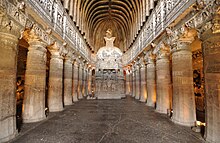
Chaitya Griha or prayer hall at Ajanta Caves in cave number 26

Bibi Ka Maqbara, also known as mini-Tajmahal.

Hazur Sahib Nanded
The state government recognises Aurangabad as the "Tourism Capital of Maharashtra".[8] There are various tourist attractions in Aurangabad. Other places visited by tourists are:
- Ajanta caves
- Ellora caves
- Udgir Fort
- Ausa
- Hazur Sahib Nanded
- Bibi Ka Maqbara
- Dharashiv Caves
- Aundha Nagnath
- Mahur
- Kandhar
Deogiri fort / *Daulatabad
- Grishneshwar temple
- Parli
- Tuljapur
- Ambajogai/Yogeshwari
- Dharur, Beed
- Ramling, Yedshi
Education

Dr. Babasaheb Ambedkar Marathwada University, Aurangabad
Marathwada has four government medical colleges, situated at Aurangabad, Latur, Nanded and Ambajogai.
The region also has good government engineering colleges such as SGGS Nanded, Aurangabad Government Engineering College.
It also has three major universities, being Dr. Babasaheb Ambedkar Marathwada University at Aurangabad, Vasantrao Naik Marathwada Agricultural University at Parbhani, and Swami Ramanand Teerth Marathwada University at Nanded.[citation needed]
The foundation of agricultural research in Marathwada region of Hyderabad state was laid by the erstwhile Nizam of Hyderabad with the commencement of the Main Experimental Farm in 1918 in Parbhani. During the Nizam's rule agricultural education was available only at Hyderabad; crop research centers for sorghum, cotton and fruits existed in Parbhani. After independence, this facility was developed further by the Indian government which was renamed as Marathwada Agriculture University on 18 May 1972.[9]
Droughts and suicide of farmers
Marathwada is affected by frequent anomalies in rainfall during Monsoon season, which accounts for almost 80 percent of the annual rainfall. The average annual rainfall over the division is 882 mm. Almost three-fourths of the Marathwada division is covered by agricultural lands. Hence, drought is having a significant impact on the life of farmers.[10] According to government records, 422 farmers in Marathwada committed suicide in 2014. This was because of their inability to bear crop losses and a financial quandary made acute by water scarcity and an agrarian crisis.[11] 2014 was the third consecutive year of low rainfall, and when rainfall did occur it was sometimes untimely and damaged crops. Of the 422 suicides, 252 cases were due to an inability to repay agricultural loans. There have been more than 117 farmer suicides in the first two months of 2017.[11] According to a study by IIT Bombay, the severe or extreme droughts have frequently occurred in major portions of Marathwada, in the last few decades.[10]
See also
- List of people from Marathwada
- Make in Maharashtra
- Manav Vikas Mission
References
Notes
^ Marathwada is not separate political or administrative entity so there is no reference of population by name of "Marathwada", population has been calculated by adding population of 8 districts of Marathwada.
Citations
^ abcd "District wise Demography". Census 2011. Retrieved 23 May 2015..mw-parser-output cite.citation{font-style:inherit}.mw-parser-output .citation q{quotes:"""""""'""'"}.mw-parser-output .citation .cs1-lock-free a{background:url("//upload.wikimedia.org/wikipedia/commons/thumb/6/65/Lock-green.svg/9px-Lock-green.svg.png")no-repeat;background-position:right .1em center}.mw-parser-output .citation .cs1-lock-limited a,.mw-parser-output .citation .cs1-lock-registration a{background:url("//upload.wikimedia.org/wikipedia/commons/thumb/d/d6/Lock-gray-alt-2.svg/9px-Lock-gray-alt-2.svg.png")no-repeat;background-position:right .1em center}.mw-parser-output .citation .cs1-lock-subscription a{background:url("//upload.wikimedia.org/wikipedia/commons/thumb/a/aa/Lock-red-alt-2.svg/9px-Lock-red-alt-2.svg.png")no-repeat;background-position:right .1em center}.mw-parser-output .cs1-subscription,.mw-parser-output .cs1-registration{color:#555}.mw-parser-output .cs1-subscription span,.mw-parser-output .cs1-registration span{border-bottom:1px dotted;cursor:help}.mw-parser-output .cs1-ws-icon a{background:url("//upload.wikimedia.org/wikipedia/commons/thumb/4/4c/Wikisource-logo.svg/12px-Wikisource-logo.svg.png")no-repeat;background-position:right .1em center}.mw-parser-output code.cs1-code{color:inherit;background:inherit;border:inherit;padding:inherit}.mw-parser-output .cs1-hidden-error{display:none;font-size:100%}.mw-parser-output .cs1-visible-error{font-size:100%}.mw-parser-output .cs1-maint{display:none;color:#33aa33;margin-left:0.3em}.mw-parser-output .cs1-subscription,.mw-parser-output .cs1-registration,.mw-parser-output .cs1-format{font-size:95%}.mw-parser-output .cs1-kern-left,.mw-parser-output .cs1-kern-wl-left{padding-left:0.2em}.mw-parser-output .cs1-kern-right,.mw-parser-output .cs1-kern-wl-right{padding-right:0.2em}
^ Kate, P. V. (1987). Marathwada under the Nizams, 1724-1948. Delhi, India: Mittal Publications. p. 3. ISBN 8170990173.
^ "Maharashtra Population Census data 2011". Government of India. Retrieved 11 April 2015.
^ "MAU". mkv. Retrieved 24 May 2015.
^ http://www.aurangabadmahapalika.org/singleIndex.jsp?orgid=95
^ "NWCMC Home Page". Nwcmc.gov.in. Retrieved 2015-05-29.
^ http://pcmcparbhani.org/
^ "World News Headlines". Newkerala.com. Retrieved 2015-05-29.
^ "MAU". mkv. Retrieved 24 May 2015.
^ ab Swain, S; et al. "Application of SPI, EDI and PNPI using MSWEP precipitation data over Marathwada, India". IEEE International Geoscience and Remote Sensing Symposium (IGARSS). 2017: 5505–5507. doi:10.1109/IGARSS.2017.8128250. Retrieved 15 June 2018.CS1 maint: Explicit use of et al. (link)
^ ab "422 farmer suicides in 2014 in Marathwada gives BJP govt the jitters | Business Standard News". Business-standard.com. 2014-12-05. Retrieved 2015-05-29.
Further reading
- Beyond Economic Development: A Case Study of Marathwada
- Vidarbha and Marathwada: Trapped in a vicious cycle -Hindustan Times
- Cane cultivation leaving Marathwada bone dry: Study -The Times of India
- Photo-essay on the 2016 drought in Marathwada
- Have India's farm suicides really declined? -BBC article
- In worst drought year, Marathwada emerges new suicide region -Indian Express
- ‘Wrong method used to calculate Vidarbha, Marathwada backlog’ - The Times of India
Lucien D. Benichou (1 January 2000). From Autocracy to Integration: Political Developments in Hyderabad State, 1938-1948. Orient Blackswan. ISBN 978-81-250-1847-6.
- Human Development Report 2002 - Maharashtra (India)
 Marathwada Marathwada | |
|---|---|
Largest city: Aurangabad Second largest: Nanded | |
| Districts of Marathwada |
|
| Cities with municipal corporations |
|
| Topics |
|
Portal: Maharashtra | |
 State of Maharashtra State of Maharashtra | |||||||||||||
|---|---|---|---|---|---|---|---|---|---|---|---|---|---|
Capital: Mumbai Second capital: Nagpur | |||||||||||||
| Topics |
| ||||||||||||
| Regions |
| ||||||||||||
| Divisions and Districts |
| ||||||||||||
| Million-plus cities in Maharashtra |
| ||||||||||||
| Other cities with municipal corporations |
| ||||||||||||
Portal: Maharashtra | |||||||||||||
Coordinates: 19°53′00″N 75°20′00″E / 19.8833°N 75.3333°E / 19.8833; 75.3333


