Bad Pyrmont
Bad Pyrmont | ||
|---|---|---|
 Train station | ||
| ||
Location of Bad Pyrmont | ||
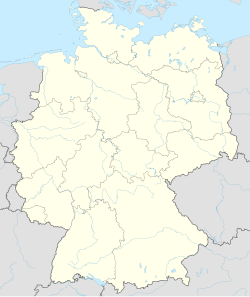  Bad Pyrmont Show map of Germany 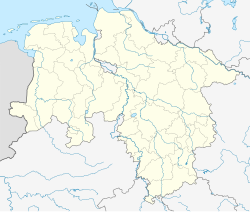 Bad Pyrmont Show map of Lower Saxony | ||
| Coordinates: 51°59′12″N 09°15′49″E / 51.98667°N 9.26361°E / 51.98667; 9.26361Coordinates: 51°59′12″N 09°15′49″E / 51.98667°N 9.26361°E / 51.98667; 9.26361 | ||
| Country | Germany | |
| State | Lower Saxony | |
| District | Hameln-Pyrmont | |
| Government | ||
| • Mayor | Klaus Blome (Ind.) | |
| Area | ||
| • Total | 61.96 km2 (23.92 sq mi) | |
| Population (2017-12-31)[1] | ||
| • Total | 19,067 | |
| • Density | 310/km2 (800/sq mi) | |
| Time zone | CET/CEST (UTC+1/+2) | |
| Postal codes | 31812 | |
| Dialling codes | 05281 | |
| Vehicle registration | HM | |
| Website | www.stadt-badpyrmont.de | |

County (Principality) of Pyrmont Grafschaft (Fürstentum) Pyrmont | |||||||||
|---|---|---|---|---|---|---|---|---|---|
| 1194–1918 | |||||||||
| Status | State of the Holy Roman Empire, State of the Confederation of the Rhine, State of the German Confederation, State of the North German Confederation, State of the German Empire | ||||||||
| Capital | Pyrmont, Lügde | ||||||||
| Government | Principality | ||||||||
| Historical era | Middle Ages | ||||||||
• Partitioned from Schwalenberg | 1194 | ||||||||
• Comital line extinct; to Spiegelberg, Lippe, Gleichen | 1494, 1557, 1583 1194 | ||||||||
• To Waldeck | 1625 | ||||||||
• | 1668 | ||||||||
• Regained independ. | 1805–12 | ||||||||
• Prussian admin. | from 1868 | ||||||||
• German Revolution | 1918 | ||||||||
• Joined Prussian province of Hanover | 1921 | ||||||||
| |||||||||


Bad Pyrmont (German pronunciation: [bat pyrˈmɔnt, ˈpyrmɔnt]) is a town in the district of Hamelin-Pyrmont, in Lower Saxony (Niedersachsen), Germany, with a population close to 19,000. It is located on the River Emmer, about 10 km west of the Weser. Bad Pyrmont is a popular spa resort that gained its reputation as a fashionable place for princely vacations in the 17th and 18th centuries. The town is also the center of the Religious Society of Friends (Quakers) in Germany.
Contents
1 History
2 Economy
3 Attractions
4 Sons and daughters of the town
5 Notable people
6 Gallery
7 See also
8 References
9 External links
9.1 Multimedia
History
Formerly called Pyrmont, it was the seat of a small county during much of the Middle Ages. The county gained its independence from the County of Schwalenberg in 1194. Independence was maintained until the extinction of the comital line in 1494, when the county was inherited by the County of Spiegelberg. In 1557, the county was inherited by Lippe, then by the County of Gleichen in 1583.
In 1625, the county became part of the much larger County of Waldeck through inheritance. In 1668, the Reichskammergericht ruled against the Bishopric of Paderborn's claims that Pyrmont had been collateral in a loan, confirming the Count of Waldeck's rights over Pyrmont, who ceded the Amt of Lügde — previously the county's capital — to the bishopric in compensation. In January 1712, the Count of Waldeck and Pyrmont was elevated to hereditary prince by Emperor Charles VI, the count having combined the two titles the previous year.
For a brief period, from 1805 to 1812, Pyrmont was again a separate principality as a result of inheritance and partition after the death of the previous prince, but the two parts were united again in 1812. The principality of Waldeck-Pyrmont retained its status after the Congress of Vienna of 1815 and became a member of the German Confederation. In 1813, the inhabitants of Pyrmont began to protest at their lack of autonomy within Waldeck–Pyrmont and the separate constitutional nature of the two territories was confirmed the following year, until a formal union was established in 1849.
From 1868 onward, the principality was administered by Prussia, but retained its legislative sovereignty. Prussian administration served to reduce administrative costs for the small state and was based on a ten-year contract that was repeatedly renewed. In 1871 it became a constituent state of the new German Empire. At the end of World War I, during the German Revolution the prince abdicated and Waldeck–Pyrmont became a free state within the Weimar Republic. On 30 November 1921, following a local plebiscite, the town and district of Pyrmont were detached and incorporated into the Prussian Province of Hanover, with Waldeck following into the Prussian province of Hesse-Nassau in 1929.
Economy
As a spa town, Bad Pyrmont's economy is heavily geared towards tourism.
Bad Pyrmonter mineral water is bottled in Bad Pyrmont.
Attractions
Bad Pyrmont features a large Kurpark, with a sizeable outdoor palm garden. The Baroque castle (1706–10) is part of a substantial complex of fortifications dating from the 16th century. The castle now houses the Museum of Municipal and Spa History. Unique in Europe is the vapor cave, where therapeutic carbon dioxide vapors emerge from the earth.[citation needed]
Sons and daughters of the town
Ferdinand Büchner, (1823–1912) flute player and composer
Sigrid Sternebeck, (born 1949) former member of the Red Army Faction
Rainer Brüninghaus, (born 1949) jazz pianist and composer
Notable people
Max Born, (1882–1970) Physicist, Nobel Prize Winner and grandfather of Olivia Newton-John, spent his last years in Bad Pyrmont
Gallery
.mw-parser-output .mod-gallery{display:table}.mw-parser-output .mod-gallery-default{background:transparent;margin-top:0.5em}.mw-parser-output .mod-gallery-center{margin-left:auto;margin-right:auto}.mw-parser-output .mod-gallery-left{float:left}.mw-parser-output .mod-gallery-right{float:right}.mw-parser-output .mod-gallery-none{float:none}.mw-parser-output .mod-gallery-collapsible{width:100%}.mw-parser-output .mod-gallery .title{display:table-row}.mw-parser-output .mod-gallery .title>div{display:table-cell;text-align:center;font-weight:bold}.mw-parser-output .mod-gallery .main{display:table-row}.mw-parser-output .mod-gallery .main>div{display:table-cell}.mw-parser-output .mod-gallery .caption{display:table-row;vertical-align:top}.mw-parser-output .mod-gallery .caption>div{display:table-cell;display:block;font-size:94%;padding:0}.mw-parser-output .mod-gallery .footer{display:table-row}.mw-parser-output .mod-gallery .footer>div{display:table-cell;text-align:right;font-size:80%;line-height:1em}.mw-parser-output .mod-gallery .gallerybox .thumb img{background:none}.mw-parser-output .mod-gallery .bordered-images img{border:solid #eee 1px}.mw-parser-output .mod-gallery .whitebg img{background:#fff!important}.mw-parser-output .mod-gallery .gallerybox div{background:#fff!important}

The promenade between the baths and Pyrmont, 1780

Schloss Pyrmont, 1900

Pyrmont baths, 1900

Schloss Pyrmont, 2007


See also
- Hannover–Braunschweig–Göttingen–Wolfsburg Metropolitan Region
Pyrmont, New South Wales, a suburb of Sydney named after Bad Pyrmont
References
^ Landesamt für Statistik Niedersachsen, Tabelle 12411: Fortschreibung des Bevölkerungsstandes, Stand 31. Dezember 2017
External links
 | Wikimedia Commons has media related to Bad Pyrmont. |
- Official website
Multimedia
- CBC Radio reports on surrender of the town, 22 April 1945
Towns and municipalities in Hamelin-Pyrmont (district) | ||
|---|---|---|
|  | |
Authority control  |
|
|---|


