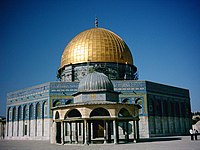
Not to be confused with The Museum for Islamic Art, Jerusalem.
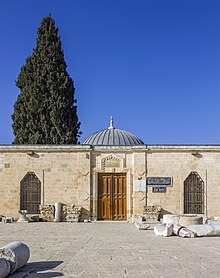
Islamic Museum entrance
Courtyard of Islamic museum on the Temple Mount
The Islamic Museum is a museum on the Temple Mount in the Old City section of Jerusalem. On display are exhibits from ten periods of Islamic history encompassing several Muslim regions. The museum is located adjacent to al-Aqsa Mosque.
Contents
1History
2Exhibits
2.1Qur'an manuscripts
3See also
4References
History
The building was originally constructed by the Knights Templar[citation needed], who used it as an annex to their headquarters established at the former Al-Aqsa Mosque. Following the Muslim reconquest of Jerusalem, the mosque was restored in 1194 AD.[1] The annex building served an assembly hall for the Fakhr al-Din Mohammad School, a madrasa built by al-Mansur Qalawun in 1282 CE, during the Mamluk era.[2] The museum was established by the Supreme Muslim Council in 1923. Shadia Yousef Touqan was the head planner of the site.[2] Khader Salameh is the head curator of the museum.[3]
Exhibits
The Islamic Museum displays large copper soup kettles used in the Haseki Sultan Imaret, a soup kitchen, built through a donation by Hürrem Sultan, the wife of Suleiman the Magnificent, dating back to the 16th century, as well as stained glass windows, wooden panels, ceramic tiles and iron doors from the reign of Suleiman the Magnificent. Also on display are a cannon used to announce the breaking of Ramadan, a large collection of weapons, a large wax tree trunk, the charred remains of a minbar built by Nur ad-Din Zangi in the 1170s and destroyed by an Australian tourist in 1969, and the blood-stained clothing of 17 Palestinians killed in the rioting on the Temple Mount in 1990.[3]
Qur'an manuscripts
The museum has 600 copies of the Qur'an donated to the al-Aqsa Mosque during the Umayyad, Abbasid, Fatimid, Ayyubid, Mamluk, Ottoman eras by caliphs, sultans, emirs, ulama and private individuals. Each differ in size, calligraphy and ornamentation. One is a hand-written Qur'an whose transcription is attributed to the great-great grandson of Muhammad. Another is written in Kufic script dating back to the 8th-9th century. A 30-part Moroccan Rab’ah was bequeathed by Sultan Abu al-Hasan al-Marini of Morocco, the only manuscript remaining from three collections that the sultan dispatched to the mosques of the three holy cities in Islam — Mecca, Medina and Jerusalem. In addition, there is a very large Qur'an measuring 100 by 90 centimetres (3.3 ft × 3.0 ft), dating back to the 14th century.[3]
^ abAl-Aqsa Library and Islamic Museum Archived 2011-08-05 at the Wayback Machine. Archenet Digital Library.
^ abcThe Islamic Museum Archived 2008-05-12 at the Wayback Machine. Jerusalemites
v
t
e
Temple Mount
Al-Aqsa Mosque
Al-Qibli Chapel
Fountain of Qasim Pasha
Murabitat
Organisation of Islamic Cooperation
Walls
Western Wall
Little Western Wall
Dung Gate
Heritage Foundation
Modesty guard
Mughrabi Bridge
Paratroopers at the Western Wall
Placing notes
Platoon of the Wall
Pro–Wailing Wall Committee
Western Stone
Western Wall camera
Wilson's Arch
Women for the Wall
Western Wall Tunnel
Other walls
Eastern Wall
Southern Wall
Hall of Hewn Stones
Temples
Solomon's Temple
Second Temple
Third Temple
The Temple Institute
Archaeological remnants
Dome of the Rock
Dome of al-Khalili
Dome of the Ascension
Dome of the Chain
Dome of the Prophet
Dome of the Rock
Dome of Yusuf
Fountain of Qayt Bay
Antiquities
Foundation Stone
Acra
Antonia Fortress
Birket Israel
Committee for the Prevention of Destruction of Antiquities on the Temple Mount
Excavations
Hasmonean Baris
Minarets
Monastery of the Virgins
Pool of Raranj
Ptolemaic Baris
Robinson's Arch
Royal Stoa
Solomon's Stables
Struthion Pool
Temple Mount Sifting Project
Gates
Al-Mawazin
Golden Gate
Huldah Gates
Warren's Gate
Conflicts
Assassination of Abdullah I
1990 Temple Mount riots
2009 Temple Mount riots
2017 Temple Mount crisis
2017 Temple Mount shooting
See also
Status quo of Holy Land sites
Hashemite custodianship of Jerusalem holy sites
Islamic Museum
Islamization
Jerusalem Islamic Waqf
Temple Mount and Eretz Yisrael Faithful Movement
Entry restrictions
Templum Domini
Temple Denial
Well of Souls
Category
v
t
e
Islamic structures on the Temple Mount
Under the Jerusalem Islamic Waqf and the Sunni Islamic Grand Mufti of Jerusalem
Mosque
al-Aqsa Mosque
Al-Qibli Chapel
Marwani Prayer Hall
Domes
Dome of the Ascension
Dome of the Chain
Dome of al-Khalili
Dome of the Prophet
Dome of the Rock
Dome of Yusuf
Fountains
Fountain of Qasim Pasha
Fountain of Qayt Bay
Pool of Raranj
Other structures
Islamic Museum
Al-Mawazin
Minarets
Minaret of Israel
Bab al-Silsila Minaret
Ghawanima Minaret
al-Fakhariyya Minaret
See also
Islamization of the Temple Mount
Jerusalem Islamic Waqf
Hashemite custodianship of Jerusalem holy sites
v
t
e
Museums with major collections of Islam-related materials
Asia
Afghanistan (Museum of Islamic Art)
Bahrain (Beit Al Quran)
India (Ibn Sina Academy of Medieval Medicine and Sciences)
Indonesia (Bayt Al Quran & Museum Istiqlal)
Iran (Astan Quds Razavi Central Museum, Museum of the Islamic Era)
Iraq (National Museum of Iraq, Sulaymaniyah Museum)
Israel/Palestine (Islamic Museum, The Museum for Islamic Art)
Jordan (Prophet Mohammad Museum)
Kuwait (Tareq Rajab Museum)
Malaysia (Islamic Arts Museum Malaysia, Islamic Heritage Museum, Kelantan Islamic Museum, Malay and Islamic World Museum, Melaka Al-Quran Museum, Melaka Islamic Museum, Penang Islamic Museum, Sabah Museum)
Maldives (National Museum)
Pakistan (Multan Museum, National Museum of Pakistan)
Philippines (Aga Khan Museum of Islamic Arts)
Qatar (Museum of Islamic Art, National Museum of Qatar, Qatar National Museum)
Saudi Arabia (Dar al-Madinah Museum, Mecca Museum)
Singapore (Asian Civilisations Museum)
Syria (National Museum of Damascus, National Museum of Aleppo, Raqqa Museum)
Turkey (Bursa Museum of Turkish and Islamic Art, İstanbul Archaeology Museums, Istanbul Museum of the History of Science and Technology in Islam, Museum of Turkish Calligraphy Art, Sadberk Hanım Museum, Topkapi Museum, Turkish and Islamic Arts Museum)
United Arab Emirates (Sharjah Museum of Islamic Civilization, Zayed National Museum)
Africa
Egypt (Museum of Islamic Art, Museum of Islamic Ceramics)
Libya (Islamic Museum of Tripoli, Red Castle Museum)
Morocco (Majorelle Garden, Marrakech Museum)
Tunisia (Bardo National Museum, Mahdia Museum, National Museum of Islamic Art)
Europe
Denmark (David Collection)
France (Arab World Institute, Louvre)
Germany (Islamic Art Museum)
Greece (Benaki Museum)
United Kingdom (British Museum, Burrell Collection, Khalili Collections, Victoria and Albert Museum)
Americas
Canada (Aga Khan Museum)
United States (America's Islamic Heritage Museum, Harvard Art Museums, Los Angeles County Museum of Art, Metropolitan Museum of Art, Walters Art Museum)
Solomon Grigor'evich Mikhlin Solomon Grigor'evich Mikhlin Born 23 April 1908 Kholmech, Minsk Governorate, Russian Empire Died 29 August 1990 (1990-08-29) (aged 82) [1] Saint Petersburg (former Leningrad) Nationality Soviet Alma mater Leningrad University (1929) Known for Elasticity theory singular integrals numerical analysis Awards Order of the Badge of Honour (1961) Laurea honoris causa by the Karl-Marx-Stadt Polytechnic (1968) Membership of the German Academy of Sciences Leopoldina (1970) Membership of the Accademia Nazionale dei Lincei (1981) Scientific career Fields Mathematics and mechanics Institutions Seismological Institute of the USSR Academy of Sciences (1932–1941) Kazakh University in Alma Ata (1941–1944) Leningrad University (now Saint Petersburg State University) (1944–1990) Academic advisors Vladimir Smirnov, Leningrad University, master thesis Doctoral students see the teaching ac...
For other uses, see Schooner (disambiguation). A traditional gaff topsail schooner Schooner rigging: 1 ) Bowsprit 2 ) Jib & fore staysail 3 ) Fore gaffsail & topsail 4 ) Main staysail 5 ) Main gaff topsail 6 ) Mainsail 7 ) End of boom A schooner / ˈ s k uː n ər / is a type of sailing vessel with fore-and-aft sails on two or more masts. The most common type has two masts, the foremast being shorter than the main. While the schooner was originally gaff-rigged, modern schooners typically carry a Bermuda rig. Contents 1 Etymology 2 History 3 Usage 4 Schooner sail plan 4.1 Schooner rationale 5 Multi-masted schooners 6 Famous schooners 7 Gallery 8 See also 9 References 10 External links Etymology Traditional square topsail schooner Shenandoah , sailing in Nantucket Sound. The first detailed definition of a schooner, describing the vessel as two-masted vessel with fore and aft gaff-rigged sails appeared in ...

 Category