朗德g因子
在物理学和化学中,朗德g{displaystyle g}
目录
1 塞曼效应
1.1 导引
1.2 推广
2 粒子物理学
2.1 电子
2.1.1 歷史沿革
2.2 其它粒子
3 注釋
4 參考文獻
5 参见
塞曼效应
塞曼效应中的朗德g{displaystyle g}
- gJ=1+J(J+1)−L(L+1)+S(S+1)2J(J+1){displaystyle g_{J}=1+{frac {J(J+1)-L(L+1)+S(S+1)}{2J(J+1)}}}

式中L,S,J{displaystyle L,S,J}
导引
朗德假定[6],当两个角动量Lℏ{displaystyle mathbf {L} hbar }

- Einteraction=Γ(L⋅S),Γ constant{displaystyle E_{text{interaction}}=Gamma (mathbf {L} cdot mathbf {S} ),quad Gamma ,{text{ constant}}}

令
- Jℏ=Lℏ+Sℏ{displaystyle mathbf {J} hbar =mathbf {L} hbar +mathbf {S} hbar }

为耦合后的总角动量,则可以证明[6],在上述形式的相互作用能下,Lℏ{displaystyle mathbf {L} hbar }
在外加磁场的作用下,带电粒子的角动量会绕外加磁场的方向进动。在这种情况下,是Jℏ{displaystyle mathbf {J} hbar }
- (L)av=J(L⋅J)J2,(S)av=J(S⋅J)J2{displaystyle (mathbf {L} )_{text{av}}={frac {mathbf {J} (mathbf {L} cdot mathbf {J} )}{J^{2}}},quad (mathbf {S} )_{text{av}}={frac {mathbf {J} (mathbf {S} cdot mathbf {J} )}{J^{2}}}}

随后,朗德进一步假定,角动量Lℏ{displaystyle mathbf {L} hbar }
- Emagnetic,L=−μ⋅B=(e2m(L)avℏ)⋅B=(L)av⋅BμB=M(L⋅J)J2μBB{displaystyle E_{{text{magnetic}},L}=-{boldsymbol {mu }}cdot mathbf {B} =left({frac {e}{2m}}(mathbf {L} )_{text{av}}hbar right)cdot mathbf {B} =(mathbf {L} )_{text{av}}cdot mathbf {B} mu _{B}={frac {M(mathbf {L} cdot mathbf {J} )}{J^{2}}}mu _{B}B}

式中μ{displaystyle {boldsymbol {mu }}}

- Emagnetic,S=M(S⋅J)J22μBB{displaystyle E_{{text{magnetic}},S}={frac {M(mathbf {S} cdot mathbf {J} )}{J^{2}}}2mu _{B}B}
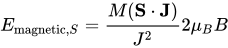
将上面结果加起来,朗德得到下列的表达式,并引入符号g{displaystyle g}
- Emagnetic=M[(L+2S)⋅J]J2μBB=gMμBB{displaystyle E_{text{magnetic}}={frac {M[(mathbf {L} +2mathbf {S} )cdot mathbf {J} ]}{J^{2}}}mu _{B}B=gMmu _{B}B}
![{displaystyle E_{text{magnetic}}={frac {M[(mathbf {L} +2mathbf {S} )cdot mathbf {J} ]}{J^{2}}}mu _{B}B=gMmu _{B}B}](https://wikimedia.org/api/rest_v1/media/math/render/svg/45be38a85df35cce55a24e8d72fc5985960ae7a0)
利用关系式L{displaystyle mathbf {L} }


- g=(L+2S)⋅JJ2=1+S⋅JJ2=1+J2−L2+S22J2{displaystyle g={frac {(mathbf {L} +2mathbf {S} )cdot mathbf {J} }{J^{2}}}=1+{frac {mathbf {S} cdot mathbf {J} }{J^{2}}}=1+{frac {J^{2}-L^{2}+S^{2}}{2J^{2}}}}

但是,朗德发现,为了与实验结果相符,这一表达式需要修改为下式,当时朗德并不清楚原因[6]。现在来看,只要将上面的角动量矢量都作为算符来处理,然后将对应的角动量平方算符用其本征值取代,得出这个结果是很自然的。
- g=1+J(J+1)−L(L+1)+S(S+1)2J(J+1){displaystyle g=1+{frac {J(J+1)-L(L+1)+S(S+1)}{2J(J+1)}}}

推广
从上面的导引可见,定义朗德g{displaystyle g}
- Emagnetic=gMμBB{displaystyle E_{text{magnetic}}=gMmu _{B}B}

上式可以等价地表述为[註 1]:
- μJ=ge2mJ{displaystyle {boldsymbol {mu }}_{J}=g{frac {e}{2m}}mathbf {J} }
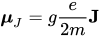
很自然的推广是将两边的J{displaystyle J}


粒子物理学
粒子物理学中的g{displaystyle g}
电子
上面的导引已经给出了电子自旋g{displaystyle g}
- ge≈−2.002319,gS=|ge|=−ge{displaystyle g_{rm {e}}approx -2.002319,g_{S}=|g_{rm {e}}|=-g_{rm {e}}}

歷史沿革
歷史上,它的理論值有過變動:
- 在非相對論量子力學理論下考慮自旋-軌道作用時,等效地說,gs{displaystyle g_{s}}
為1。
- 若再額外考慮狹義相對論時間展長效應下的湯瑪斯進動修正(1927年),gs{displaystyle g_{s}}
- 若再額外考慮狹義相對論時間展長效應下的湯瑪斯進動修正(1927年),gs{displaystyle g_{s}}
- 在相對論量子力學,也就是指保羅·狄拉克所提出的理論(1928年),gs{displaystyle g_{s}}
- 在量子電動力學(QED)中,因為電子與真空能量的電磁漲落交互作用,可表為單環費因曼圖,提出QED的朱利安·施温格等人(1947年)所得的gs{displaystyle g_{s}}
[7];α目前被視為是自然常數之一,其值約為1137.035 999 11(46){displaystyle {frac {1}{137.035 999 11(46)}}}
。
威利斯·蘭姆等人實驗觀測到的蘭姆位移效應,所得gs{displaystyle g_{s}}
其它粒子
一些粒子的朗德g{displaystyle g}
粒子 | 朗德g{displaystyle g}因子 | Δg |
|---|---|---|
电子 | -2.002 319 304 361 53 | 0.000 000 000 000 53 |
中子 | -3.826 085 45 | 0.000 000 90 |
质子 | 5.585 694 713 | 0.000 000 046 |
μ子 | -2.002 331 8418 | 0.000 000 0013 |
注釋
^ 这里的J{displaystyle mathbf {J} }
參考文獻
^ A. Landé. Über den anomalen Zeemaneffekt (Teil I). Zeitschrift für Physik. 1921-07-01, 5 (4): 231–241 [2018-04-02]. ISSN 0044-3328. doi:10.1007/bf01335014 (德语).
^ A. Landé. Über den anomalen Zeemaneflekt (II. Teil). Zeitschrift für Physik. 1921-12-01, 7 (1): 398–405 [2018-04-02]. ISSN 0044-3328. doi:10.1007/bf01332807 (德语).
^ A. Landé. Zur Theorie der anomalen Zeeman- und magneto-mechanischen Effekte. Zeitschrift für Physik. 1922-12-01, 11 (1): 353–363 [2018-04-02]. ISSN 0044-3328. doi:10.1007/bf01328427 (德语).
^ A. Landé. Termstruktur und Zeemaneffekt der Multipletts. Zeitschrift für Physik. 1923-12-01, 15 (1-2): 189–205 [2018-04-02]. ISSN 0044-3328. doi:10.1007/bf01330473 (德语).
^ Quantum Chemistry: Fifth Edition, Ira N. Levine, 2000
^ 6.06.16.26.36.46.5 John C. Slater. 10. Quantum Theory of Atomic Structure. 1960. ISBN 9780070580404.
^ V. W. Hughes and T. Kinoshita "Anomalous g values of the electron and muon" Review of Modern Physics 71, 133(1999)
^ CODATA Values of the Fundamental Constants.
参见
- 波耳磁子
- 湯瑪斯進動
- 量子電動力學
- 電子自旋共振


