Magpie
| Magpie | |
|---|---|
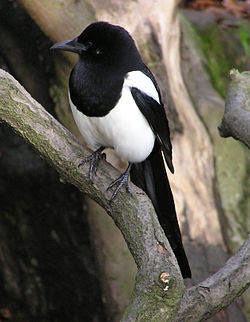 | |
Eurasian magpie | |
Scientific classification | |
| Kingdom: | Animalia |
| Phylum: | Chordata |
| Class: | Aves |
| Order: | Passeriformes |
| Family: | Corvidae |
| Genera | |
| |

Sitting magpie, Sweden 2016
Magpies are birds of the Corvidae (crow) family. The black and white Eurasian magpie is widely considered one of the most intelligent animals in the world[1][2][3] and one of only a few non-mammal species able to recognize itself in a mirror test.[4] In addition to other members of the genus Pica, corvids considered as magpies are in the genera Cissa.
Magpies of the genus Pica are generally found in temperate regions of Europe, Asia and western North America, with populations also present in Tibet and high elevation areas of India, i.e. Ladakh (Kargil and Leh) and Pakistan. Magpies of the genus Cyanopica are found in East Asia and also the Iberian peninsula. The birds called magpies in Australia are not related to the magpies in the rest of the world (see Australian magpie).
Contents
1 Systematics and species
2 Other "magpies"
3 Gallery
4 References
5 Bibliography
6 Further reading
7 External links
Systematics and species
According to some studies, magpies do not form the monophyletic group they are traditionally believed to be—a long tail has certainly elongated (or shortened) independently in multiple lineages of corvid birds.[5] Among the traditional magpies, there appear to be two distinct lineages. One consists of Holarctic species with black/white colouration and is probably closely related to crows and Eurasian jays. The other contains several species from South to East Asia with vivid colouration which is predominantly green or blue. The azure-winged magpie and the Iberian magpie, formerly thought to constitute a single species with a most peculiar distribution, have been shown to be two distinct species and classified as the genus Cyanopica.[6]
Other research has cast doubt on the taxonomy of the Pica magpies, since it appears that P. hudsonia and P. nuttalli may not be different species, whereas the Korean race of P. pica is genetically very distinct from the other Eurasian (as well as the North American) forms. Either the North American, Korean, and remaining Eurasian forms are accepted as three or four separate species, or there exists only a single species, Pica pica.[7]
Holarctic (black-and-white) magpies
- Genus Pica
Eurasian magpie, Pica pica
Black-billed magpie, Pica hudsonia (may be conspecific with P. pica)
Yellow-billed magpie, Pica nuttalli (may be conspecific with P. (pica) hudsonia)
Asir magpie, Pica asirensis (may be conspecific with P. pica)
Maghreb magpie, Pica mauritanica (may be conspecific with P. pica)
Korean magpie, Pica sericea (may be conspecific with P. pica)
Oriental (blue/green) magpies
- Genus Urocissa
Taiwan blue magpie, Urocissa caerulea
Red-billed blue magpie, Urocissa erythrorhyncha
Yellow-billed blue magpie, Urocissa flavirostris
White-winged magpie, Urocissa whiteheadi
Sri Lanka blue magpie, Urocissa ornata
- Genus Cissa
Common green magpie, Cissa chinensis
Indochinese green magpie, Cissa hypoleuca
Javan green magpie, Cissa thalassina
Bornean green magpie, Cissa jefferyi
Azure-winged magpies
- Genus Cyanopica
Azure-winged magpie, Cyanopica cyanus
Iberian magpie, Cyanopica cooki
Other "magpies"
- The black magpie, Platysmurus leucopterus, is a treepie; it is neither a magpie nor, as was long believed, a jay. Treepies are a distinct group of corvids externally similar to magpies.
- The Australian magpie, Gymnorhina tibicen, is conspicuously piebald, with black and white plumage reminiscent of a European magpie. It is a member of the family Artamidae and not a corvid.
Gallery

Sri Lanka blue magpie

Indochinese green magpie
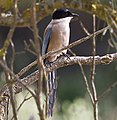
Iberian magpie
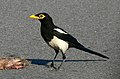
Yellow-billed magpie


References
^ "World's smartest birds - Welcome Wildlife". welcomewildlife.com. 3 January 2017..mw-parser-output cite.citation{font-style:inherit}.mw-parser-output q{quotes:"""""""'""'"}.mw-parser-output code.cs1-code{color:inherit;background:inherit;border:inherit;padding:inherit}.mw-parser-output .cs1-lock-free a{background:url("//upload.wikimedia.org/wikipedia/commons/thumb/6/65/Lock-green.svg/9px-Lock-green.svg.png")no-repeat;background-position:right .1em center}.mw-parser-output .cs1-lock-limited a,.mw-parser-output .cs1-lock-registration a{background:url("//upload.wikimedia.org/wikipedia/commons/thumb/d/d6/Lock-gray-alt-2.svg/9px-Lock-gray-alt-2.svg.png")no-repeat;background-position:right .1em center}.mw-parser-output .cs1-lock-subscription a{background:url("//upload.wikimedia.org/wikipedia/commons/thumb/a/aa/Lock-red-alt-2.svg/9px-Lock-red-alt-2.svg.png")no-repeat;background-position:right .1em center}.mw-parser-output .cs1-subscription,.mw-parser-output .cs1-registration{color:#555}.mw-parser-output .cs1-subscription span,.mw-parser-output .cs1-registration span{border-bottom:1px dotted;cursor:help}.mw-parser-output .cs1-hidden-error{display:none;font-size:100%}.mw-parser-output .cs1-visible-error{font-size:100%}.mw-parser-output .cs1-subscription,.mw-parser-output .cs1-registration,.mw-parser-output .cs1-format{font-size:95%}.mw-parser-output .cs1-kern-left,.mw-parser-output .cs1-kern-wl-left{padding-left:0.2em}.mw-parser-output .cs1-kern-right,.mw-parser-output .cs1-kern-wl-right{padding-right:0.2em}
^ Connor, Steve (19 August 2008). "Magpies reflect on a newly discovered intellectual prowess". The Independent.
^ "Eurasian Magpie: A True Bird Brain". britannica.com.
^ Prior H, et al. (2008). De Waal F, ed. "Mirror-Induced Behavior in the Magpie (Pica pica): Evidence of Self-Recognition". PLoS Biology. Public Library of Science. 6 (8): e202. doi:10.1371/journal.pbio.0060202. PMC 2517622. PMID 18715117. Retrieved 2008-08-21.
^ Ericson et al. (2005)
^ Kyukov et al, Synchronic east–west divergence in azure-winged magpies (Cyanopica cyanus) and magpies (Pica pica), Journal of Zoological Systematics and Evolutionary Research 42(4): 342-351 (2004)
^ Lee et al., 2003
Bibliography
- Ericson, Per G. P.; Jansén, Anna-Lee; Johansson, Ulf S. & Ekman, Jan (2005): Inter-generic relationships of the crows, jays, magpies and allied groups (Aves: Corvidae) based on nucleotide sequence data. Journal of Avian Biology 36: 222–234.
- Lee, Sang-im; Parr, Cynthia S.; Hwang, Youna; Mindell, David P. & Choe, Jae C. (2003): Phylogeny of magpies (genus Pica) inferred from mtDNA data. Molecular Phylogenetics and Evolution 29: 250–257.
Further reading
Song, S.; Zhang, R.; Alström, P.; Irestedt, M.; Cai, T.; Qu, Y.; Ericson, P.G.P.; Fjeldså, J.; Lei, F. (2017). "Complete taxon sampling of the avian genus Pica (magpies) reveals ancient relictual populations and synchronous Late-Pleistocene demographic expansion across the Northern Hemisphere". Journal of Avian Biology. doi:10.1111/jav.01612.
External links
Magpie videos, photos and sounds on the Internet Bird Collection


