Guastalla
Guastalla | ||
|---|---|---|
Comune | ||
| Città di Guastalla | ||
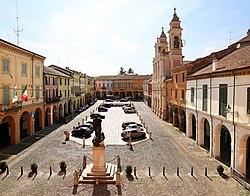 | ||
| ||
Location of Guastalla | ||
  Guastalla Location of Guastalla in Italy Show map of Italy  Guastalla Guastalla (Emilia-Romagna) Show map of Emilia-Romagna | ||
| Coordinates: 44°55′N 10°40′E / 44.917°N 10.667°E / 44.917; 10.667 | ||
| Country | Italy | |
| Region | Emilia-Romagna | |
| Province | Reggio Emilia (RE) | |
| Frazioni | Pieve, San Giacomo, San Giorgio, San Girolamo, San Martino, San Rocco, Tagliata | |
| Government | ||
| • Mayor | Camilla Verona | |
| Area | ||
| • Total | 52.5 km2 (20.3 sq mi) | |
| Elevation | 24 m (79 ft) | |
| Population (31 December 2016)[1] | ||
| • Total | 15,100 | |
| • Density | 290/km2 (740/sq mi) | |
| Demonym(s) | Guastallesi | |
| Time zone | UTC+1 (CET) | |
| • Summer (DST) | UTC+2 (CEST) | |
| Postal code | 42016 | |
| Dialing code | 0522 | |
| Patron saint | St. Francis | |
| Saint day | October 4 | |
| Website | Official website | |

Guastalla (Guastallese: Guastàla) is a town and comune in the province of Reggio Emilia in Emilia-Romagna, Italy.
Contents
1 Geography
2 History
2.1 Industry
3 Main sights
4 Twin Towns
5 Residents
6 See also
7 References
Geography
Guastalla is situated in the Po Valley, and lies on the banks of the Po River. Guastalla is located at around 30 kilometres (19 mi) from the cities of Reggio Emilia, Parma, and Mantua.
History
The area of Guastalla was probably settled by Etruscans as early as the 7th century BCE, but the name of the city is mentioned for the first time in 864 CE. Of Lombard origin, the city was ruled by the Torelli family from 1406 to 1539, when it became the capital of a duchy under the Gonzaga family and housed artists like Guercino and Torquato Tasso.
In 1748, by the Treaty of Aix-la-Chapelle, the city became part of the Duchy of Parma, Piacenza e Guastalla, to which it belonged until 1847, when it was inherited by the Duke of Modena. Since the unification of Italy in 1861 Guastalla has been a part of Italy.
Industry
SMEG, a major manufacturer of high-design domestic appliances, was founded by Vittorio Bertazzoni in Guastalla in 1948, where it still has its headquarters.
Main sights
Guastalla town:
- The Cathedral (16th century) by Francesco da Volterra.
- The Ducal Palace of Guastalla (1567).
- The Civic Theatre Ruggero Ruggeri (1671).
- The Town Hall.
- The octagonal Oratory of Madonna della Concezione.
- The church of Santa Maria dei Servi, designed by Francesco da Volterra. Noteworthy in the interior is a Deposition, canvas by Giuseppe Maria Crespi.
- The Civic Tower (18th century), in the location where once was the Spanish Castle
Around Guastalla:
- The Romanesque Oratory of St. George (probably from the 9th century).
- The Basilica of St. Peter at Pieve di Guastalla, which was seat of two Roman Catholic councils. It houses an ancient baptismal font (9th century) and painted terracotta portraying the Madonna with Child, attributed to Guido Mazzoni.
Twin Towns
 Forcalquier, France[2]
 Giovinazzo, Italy[3]
Gabicce Mare, Italy[4]


Residents
In-Grid, Italian pop-dance artist
See also
- County of Guastalla
- Duchy of Guastalla
- Rulers of Guastalla
- Diocese of Guastalla
References
^ ISTAT Archived 2016-03-03 at the Wayback Machine.
^ "Gemellaggio_1" (in Italian)..mw-parser-output cite.citation{font-style:inherit}.mw-parser-output q{quotes:"""""""'""'"}.mw-parser-output code.cs1-code{color:inherit;background:inherit;border:inherit;padding:inherit}.mw-parser-output .cs1-lock-free a{background:url("//upload.wikimedia.org/wikipedia/commons/thumb/6/65/Lock-green.svg/9px-Lock-green.svg.png")no-repeat;background-position:right .1em center}.mw-parser-output .cs1-lock-limited a,.mw-parser-output .cs1-lock-registration a{background:url("//upload.wikimedia.org/wikipedia/commons/thumb/d/d6/Lock-gray-alt-2.svg/9px-Lock-gray-alt-2.svg.png")no-repeat;background-position:right .1em center}.mw-parser-output .cs1-lock-subscription a{background:url("//upload.wikimedia.org/wikipedia/commons/thumb/a/aa/Lock-red-alt-2.svg/9px-Lock-red-alt-2.svg.png")no-repeat;background-position:right .1em center}.mw-parser-output .cs1-subscription,.mw-parser-output .cs1-registration{color:#555}.mw-parser-output .cs1-subscription span,.mw-parser-output .cs1-registration span{border-bottom:1px dotted;cursor:help}.mw-parser-output .cs1-hidden-error{display:none;font-size:100%}.mw-parser-output .cs1-visible-error{font-size:100%}.mw-parser-output .cs1-subscription,.mw-parser-output .cs1-registration,.mw-parser-output .cs1-format{font-size:95%}.mw-parser-output .cs1-kern-left,.mw-parser-output .cs1-kern-wl-left{padding-left:0.2em}.mw-parser-output .cs1-kern-right,.mw-parser-output .cs1-kern-wl-right{padding-right:0.2em}
^ "Gemellaggio_2" (in Italian).
^ "Gemellaggio_3" (in Italian).
Emilia-Romagna · Comuni of the Province of Reggio Emilia | ||
|---|---|---|
 |
| |
 | This article on a location in Emilia–Romagna is a stub. You can help Wikipedia by expanding it. |


